Share article on


.svg)


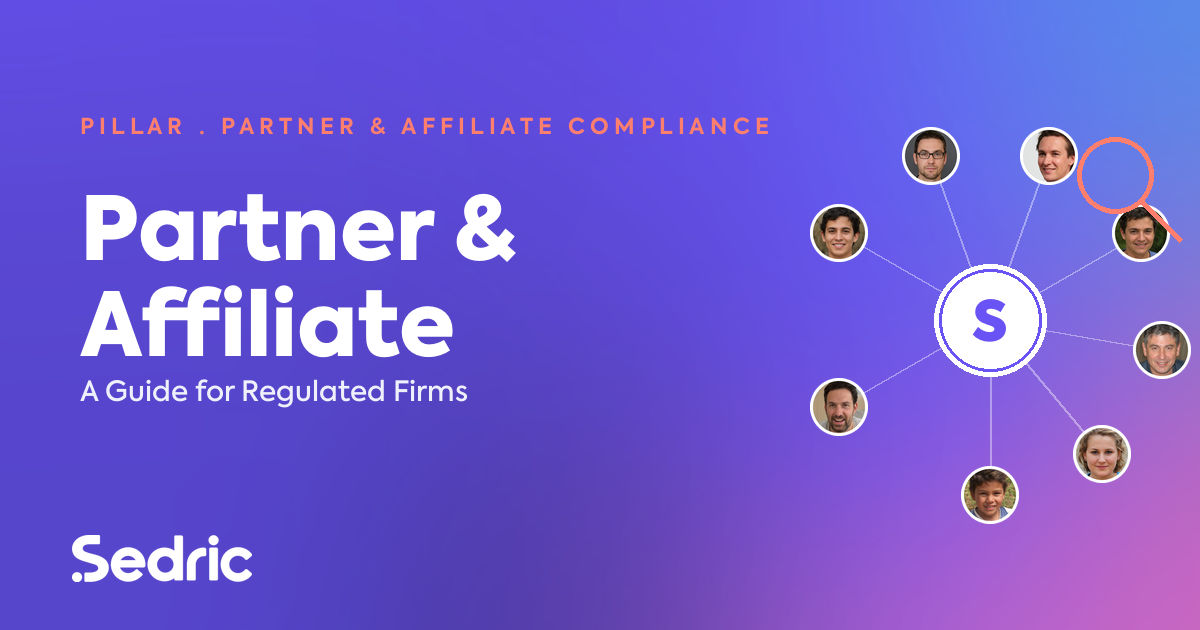
Partner and affiliate compliance is the structured discipline of supervising every customer-facing communication produced on a regulated firm’s behalf by a third party — affiliates, finfluencers, brand ambassadors, BaaS partners, distribution partners, sponsored creators, and the long tail of paid spokespeople who reach customers in places the firm itself does not. In financial services, banking, insurance, and healthcare, it is the regulator-facing answer to a question that has produced an enormous wave of fines over the past three years: your partners said something to your customers; how do you know it was compliant?
If you run compliance, marketing, or partner operations at a regulated firm, the way you supervise third-party content directly determines two things: how confidently you can scale partner-driven distribution, and how badly you get hurt when a regulator starts a sweep through your influencer roster. This guide walks through what partner and affiliate compliance actually is, the regulatory frameworks that govern it across industries, what a modern partner-supervision workflow looks like end-to-end, the pitfalls that have produced eight-figure fines in the last 24 months, and how AI is reshaping the discipline in 2026.
Partner and affiliate compliance is the firm’s end-to-end answer to a simple regulatory test: show us every piece of communication your partners published on your behalf, prove it was approved, prove it was monitored after publication, and prove the partner program itself was supervised at the program level. The discipline operates across three layered surfaces: the partner (who they are, what they’ve been authorized to say, what training they’ve received), the content (every asset they publish, in every channel, before and after it goes live), and the program (the contracts, policies, supervisory procedures, and metrics that hold the whole structure together).
The scope is wider than most firms initially budget for. Affiliate marketers driving credit-card applications, finfluencers promoting brokerage accounts, sponsored creators on TikTok and Instagram, BaaS fintech partners running co-branded campaigns, broker-dealer registered representatives who post on LinkedIn, asset managers’ promoter networks under the SEC Marketing Rule, insurance MGAs and IMOs, mortgage broker networks, and the customer-service BPOs that handle inbound calls under the firm’s name. Every one of those surfaces is a covered communication when a regulator looks at it.
A defensible partner compliance program produces three deliverables on every partner-driven communication: an approved version (or a documented post-publication review with a clear disposition), an audit trail showing who approved it and when, and an immutable archive of what was actually published. Without all three, the firm is exposed even on partner content that happens to be perfectly compliant.
Between March 2024 and May 2025, FINRA opened a coordinated campaign against firms that paid social-media influencers to promote their products without an adequate supervisory framework. The settlements in this wave are the most concrete evidence that partner compliance has graduated from a marketing-operations question to a front-line operational risk function:
FINRA’s Bill St. Louis, Executive Vice President and Head of Enforcement, was explicit: “FINRA will continue to consider whether firms are using practices and maintaining supervisory systems that are reasonably designed to address the risks related to social media influencer programs.”
For firms outside the U.S. broker-dealer space, the pressure looks different but the substance is the same. The UK’s Financial Conduct Authority caused 19,766 financial promotions to be amended or withdrawn in 2024 alone, an order of magnitude above the prior decade’s baseline, with finfluencers a primary target. The CFPB has cited partner-channel marketing in multiple UDAAP cases against banks and BaaS arrangements. Banking regulators jointly issued the Interagency Guidance on Third-Party Relationships: Risk Management in June 2023, formalizing supervisory expectations on partner due diligence and ongoing monitoring across the full third-party lifecycle.
Partner and affiliate compliance is no longer something a firm can solve at the end of a campaign. It is the firm’s primary defense against a category of regulatory risk that has produced multi-million-dollar settlements, shareholder lawsuits, and senior-leadership departures.
Any business whose distribution depends on third parties subject to sector-specific rules needs a formal partner compliance program. That includes, at minimum:
If your firm sits in any of these categories, every dollar paid to a third party for distribution is also a dollar that pulls a regulator-facing supervisory obligation along with it.
The substantive rules vary by sector, but the structural pattern across them is consistent: vet the partner, approve the content before publication where required, monitor the content after publication, archive the record, and supervise the program itself with documented procedures and metrics. Below is a working map of the frameworks that drive most U.S. and UK partner programs today.
The FTC Endorsement Guides, substantially revised in June 2023, set the cross-industry baseline for any paid endorser relationship. The core requirements: clearly and conspicuously disclose any material connection between the endorser and the firm; ensure endorsements reflect the endorser’s honest opinions and experiences; and avoid representations the firm itself would not be able to make. The 2023 revisions tightened the “clear and conspicuous” standard, expanded liability for advertisers and intermediaries, and added explicit language on social-media disclosures, fake reviews, and incentivized testimonials. For any consumer-facing affiliate or influencer program, the FTC Endorsement Guides are the floor — sector-specific rules build on top of them.
For broker-dealers, partner-driven content is governed by FINRA Rule 2210 (communications with the public) plus a series of Regulatory Notices that address social media, blogs, websites, and digital communications. Rule 2210 classifies partner content into retail, correspondence, or institutional categories and applies different supervisory requirements to each. Retail communications generally require principal pre-approval. Notice 10-06 set the original framework for social-media supervision. Notice 11-39 extended it to interactive electronic communications. Notice 17-18 (the social-media supervision update) reinforced expectations on third-party content adoption and entanglement, and on personal social-media use by registered representatives. The recent finfluencer enforcement wave applies this framework directly to paid influencer content.
The SEC’s amended Marketing Rule, fully effective in November 2022, modernized the rules around testimonials, endorsements, and third-party ratings — effectively legalizing many uses that the prior rule prohibited, but with strict substantive conditions. Compensated testimonials and endorsements are now permissible if the adviser provides clear and prominent disclosure of (i) whether the speaker is a client/non-client, (ii) cash or non-cash compensation, and (iii) any material conflicts. The adviser must have a written agreement with the promoter and oversee the promoter’s communications. For an RIA running any kind of promoter program — from a single referral relationship to a finfluencer roster — partner compliance is no longer optional.
In June 2023, the OCC, FDIC, and Federal Reserve jointly issued the Interagency Guidance on Third-Party Relationships: Risk Management, replacing prior agency-specific guidance and setting unified expectations across the third-party lifecycle: planning, due diligence and selection, contract negotiation, ongoing monitoring, and termination. The guidance is risk-based and flexible, but the supervisory expectation is clear: banks own the risk of their partners’ conduct, including their consumer communications. For BaaS arrangements, the sponsor bank is accountable for fintech partners’ UDAAP exposure, fair-lending posture, and marketing accuracy. For a deeper treatment of how UDAAP runs through partner-channel marketing, see Sedric’s analysis of how AI can help tame UDAAP risk.
The CFPB’s UDAAP authority extends to partners of regulated entities, and the Bureau has explicitly stated that the regulated entity is responsible for its service providers’ compliance. For affiliate marketers driving credit applications, the firm must supervise both the partner’s representations and the firm’s own follow-on flows. TILA / Regulation Z triggering-term rules apply equally to partner ads and direct firm ads. RESPA constraints on referral fees, the SAFE Act for mortgage-loan-originator marketing, and fair-lending considerations under ECOA all attach to partner activity.
In the UK, section 21 of FSMA prohibits a person from communicating a financial promotion in the course of business unless approved by an authorized person or exempt. The 2023 amendments to the financial-promotions regime tightened the gateway for s.21 approvers and added specific requirements for promotions of high-risk investments and crypto-assets. The Consumer Duty (in force since July 2023) requires firms to act to deliver good outcomes for retail customers in their communications — explicitly extending to partner-channel content. The FCA’s 2024 enforcement sweep of finfluencers makes the supervisory expectation unmistakable.
Layered on top of the federal frameworks, every state has its own UDAP statute (often called “Little FTC Acts”) that state attorneys general can wield against partner-driven misrepresentations. State privacy laws (CCPA/CPRA, the parallel laws in Virginia, Colorado, Connecticut, Utah, Texas, and others) constrain partner data flows. Platform rules — Google Ads policies, Meta’s special-ad-category requirements for credit and financial services, TikTok’s creator policies — add another set of constraints that, while not regulator-issued, can produce business-disrupting account terminations.
A defensible partner compliance program is a documented end-to-end pipeline that connects partner onboarding to content approval to post-publication monitoring to program-level oversight. The shape of that pipeline is broadly the same across regulated industries.
Every partner enters the program through a single intake gate. Onboarding captures the partner’s identity (KYC equivalent), business model, audience, prior compliance history, channel mix, and the specific products or services they will promote. The firm runs documented due diligence proportionate to the risk — for a high-volume finfluencer reaching retail investors, that is meaningful diligence. Onboarding ends with a signed partner agreement that codifies the firm’s rules of the road, the partner’s obligations, the firm’s right to review and remove content, and termination triggers.
Onboarded partners go through training calibrated to the regulatory framework that governs them — FTC disclosure mechanics, sector-specific prohibited claims, required risk language, and the firm’s brand and policy library. The asset library gives partners pre-approved content (graphics, claims language, comparison disclosures, sample posts) that significantly reduces the rate of post-publication remediation.
For high-risk partner content — new product launches, performance claims, cross-jurisdiction campaigns — partners submit drafts through the firm’s review workflow before publishing. Reviewers run substantive checks (FINRA 2210 standards, FTC disclosure requirements, sector-specific overlays), redline drafts, and route for principal approval where required. The output is an approved version that is the only version authorized for publication. For the playbook on how this works for the firm’s own marketing, see Sedric’s pillar on marketing review for regulated industries.
The biggest weakness in legacy partner programs is the gap between “we approved the asset” and “the asset went live and stayed compliant.” Modern partner compliance closes the gap with continuous post-publication monitoring across every channel the partner publishes on — Instagram, TikTok, YouTube, X, LinkedIn, Reddit, podcasts, blogs, partner websites. The monitoring engine compares what was approved to what was published, flags drift, and alerts the firm in time to intervene before the regulator does.
When a partner’s content drifts — the disclosure has been removed, a new product feature has been added without approval, the post has been “updated” into a different message — the workflow triggers remediation. Depending on the severity, that ranges from a friendly note to the partner, to a takedown demand, to suspension and program-level escalation. Each remediation is documented in the audit trail.
Every approved version, every published version, every drift event, and every remediation is captured in a tamper-evident archive that satisfies the firm’s applicable recordkeeping rule (3 years for broker-dealers under SEA 17a-4, 5 years for advisers under Rule 204-2, longer for some state insurance regimes). The archive must be queryable on regulator demand within standard production windows.
The program itself is supervised, not just individual content. Periodic program-level reviews ask: which partners are highest-risk, which produce the most remediation events, which channels carry the most drift, which products have the highest violation rate? The output is a continuous re-tiering of the partner roster and a documented reauthorization decision (continue, restrict, terminate). This is the program-level supervisory document the regulator asks for first during an exam.
For a granular treatment of the finfluencer-specific enforcement landscape and how AI changes the supervisory picture, see Sedric’s analysis of finfluencers in FINRA’s crosshairs.
The same patterns recur across nearly every partner-program enforcement action. Knowing them is half of avoiding them.
The hard part of partner compliance is not running the workflow once. It is running it consistently, across hundreds or thousands of partners, in dozens of channels, in multiple jurisdictions, at the velocity modern partner-driven distribution operates at.
A few program-level decisions separate scalable programs from the ones that produce eight-figure settlements:
Centralized partner registry. Every partner, every channel, every contract, every authorization in one queryable system. Firms with separate registries per business unit cannot answer a regulator’s “list every partner who promoted Product X in Q3” request.
Risk-tiered supervision. A retail-investor finfluencer with 500K followers gets denser supervision than a mid-volume affiliate marketer driving credit-card applications. Tiering by risk lets the program apply the deepest scrutiny where regulator interest actually focuses.
Codified policy library, partner-aware. The firm’s rules of the road are encoded as a structured library — required disclosures by product and jurisdiction, prohibited claim categories, FTC disclosure templates, sector-specific overlays. Partners draft against the library; reviewers check against it; monitoring continuously enforces it.
Continuous monitoring across every channel a partner publishes on. Sampling is the legacy model and it produces enforcement actions. A modern program scans Instagram, TikTok, YouTube, podcasts, blogs, X, LinkedIn, and the partner’s own websites in near real time and flags drift the moment it appears.
Defensible documentation by default. Every onboarding decision, every content approval, every remediation event, every program-level reauthorization is captured automatically as a byproduct of the workflow. Documentation that depends on a human remembering to add it will fail.
Metrics the regulator will ask for. Number of active partners, partner risk distribution, content approval throughput, post-publication drift rate, time-to-remediation, percentage of channels under continuous monitoring, audit-readiness score. The program is only as good as the metrics it can show on the morning of an exam.
Partner compliance has historically been a manual, sample-based discipline. A reviewer read partner submissions, a sampling team checked a few live posts a quarter, and a compliance officer hoped nothing went off the rails between samples. That model worked when partner programs were measured in dozens of partners and a handful of channels. It does not scale to a world where a single firm runs thousands of partner relationships across the full social, podcast, and creator surface.
AI is reshaping the discipline in three concrete ways. First, large language models can read partner content in context — understanding promissory framing, missing disclosures, and inferential claims — at a speed and consistency human review teams cannot match. Second, AI can run continuous monitoring across every public channel a partner publishes on, comparing live content to the approved baseline and flagging drift the moment it appears. Third, AI can risk-score the partner roster itself, surfacing the partners and channels most likely to produce a violation before they actually do.
The risk is also real. A monitoring system that hallucinates flags wastes the compliance team’s time and damages partner relationships. The bar is human-in-the-loop oversight, model documentation, explainability of every flag, and continuous validation. Regulators have been explicit that AI partner-supervision tools must be governed with the same rigor as any other compliance control.
Used well, AI takes partner compliance from a sampling discipline that catches problems weeks late to a continuous discipline that catches them in hours. Used carelessly, it just creates a faster way to ship the same problems at scale.
Sedric is an AI compliance platform built specifically for regulated marketing, communications, and partner content. Its partner compliance product sits across the workflow described above — partner onboarding, content pre-approval, post-publication monitoring, drift detection, remediation, and program-level supervision — and applies a regulator-tuned policy engine to every partner-driven communication. The platform encodes the relevant frameworks (FTC Endorsement Guides, FINRA Rule 2210 and Notices 10-06/11-39/17-18, the SEC Marketing Rule promoter provisions, the 2023 Interagency Guidance for banks, CFPB UDAAP standards, FCA financial promotions, MiFID II conduct, and the firm’s own internal policies) as a structured rule library, runs every covered communication against that library, and produces an explainable, auditable decision with a complete record.
In practice, that means partner-program teams onboard partners faster, content gets cleared in minutes rather than days, monitoring runs continuously across every public channel where partners publish, drift gets caught in hours, and the firm walks into any regulator exam with a complete, queryable archive of every partner, every authorization, every reviewed asset, and every remediation. Sedric’s broader platform extends the same approach to first-party marketing and customer communications — the surfaces where most of the recent enforcement action has actually occurred. Firms can read more about the underlying AI Reviewer for a closer look at how the policy engine is applied at scale.
The point is not that AI replaces the principal, the compliance officer, or the partner-program manager. It does not, and regulators do not expect it to. The point is that a modern partner compliance program treats human judgment as the scarce resource and uses AI to apply that judgment consistently across a much larger volume of partner content than any team could supervise by hand.
Partner compliance is the discipline of supervising every customer-facing communication produced on a regulated firm’s behalf by a third party — affiliates, finfluencers, brand ambassadors, BaaS partners, distribution partners, and paid spokespeople. It involves vetting partners, approving content where required, monitoring published content continuously across every channel the partner uses, archiving every version, and supervising the program itself with documented procedures and metrics.
Both fall under the broader partner-compliance umbrella. “Affiliate compliance” typically refers to performance-marketing partners driving traffic and conversions, often through websites, email, and paid media. “Finfluencer compliance” specifically addresses social-media personalities promoting financial products. The regulatory frameworks overlap heavily — FTC Endorsement Guides apply to both; FINRA Rule 2210 and recent finfluencer enforcement extend the same supervisory expectations.
The regulated firm is responsible for the content its partners publish on its behalf. This is the unambiguous position of FINRA, the SEC, the CFPB, the FCA, and the federal banking agencies. The firm cannot delegate the supervisory obligation to the partner. Partner agreements that purport to shift liability do not shift the regulator-facing obligation.
In manual programs, partner content reviews typically take three days to two weeks depending on asset complexity, jurisdiction, and product line. AI-assisted programs routinely cut that to minutes for low-risk assets and hours for high-risk ones, with human reviewers focused on exceptions. Faster review is also a partner-retention tool — partners default to the firms that move quickest.
At minimum: the partner agreement, training records, every submitted draft, every reviewer comment, every approval signature, the final published version, every drift event, every remediation action, and the dates and identities associated with each. Retention periods follow the firm’s sector-specific rule — three years for broker-dealers under SEA 17a-4, five years for advisers under Rule 204-2, longer for some state insurance regimes.
Yes, in most cases. The FTC’s 2023 revisions clarified that material-connection disclosures apply across endorsement contexts, including B2B and influencer-to-influencer arrangements where the audience could reasonably perceive the endorsement as independent. Some narrow B2B contexts where the audience already understands the commercial relationship may not require disclosures, but the safe practice is to disclose.
No, and regulators are clear on this point. AI can dramatically expand monitoring coverage, apply the firm’s policy library more consistently than any human team, and triage the partner roster so reviewers focus where the risk is. But the principal’s sign-off, the program-level supervisory documentation, and regulator-facing accountability remain human responsibilities. AI is the senior analyst that never sleeps; the principal is still the principal.
Partner and affiliate compliance is, in the end, the firm’s answer to a single regulator question: your partners said something to your customers; show us how you made sure it was compliant. The firms that answer that question well have a centralized partner registry, a codified policy library, continuous monitoring across every public channel where partners publish, defensible documentation produced as a byproduct of the workflow, and the technology to apply that machinery at the scale of modern partner-driven distribution. The firms that answer it badly are the ones that paid seven- and eight-figure fines because they couldn’t. Partner compliance is no longer a back-office checkbox. In regulated industries, it is the difference between scaling distribution and explaining distribution. The discipline is worth getting right.

Convert your static procedures into active AI controllers that protect your brand 24/7.



.svg)

Scale marketing compliance without slowing down.