Share article on


.svg)


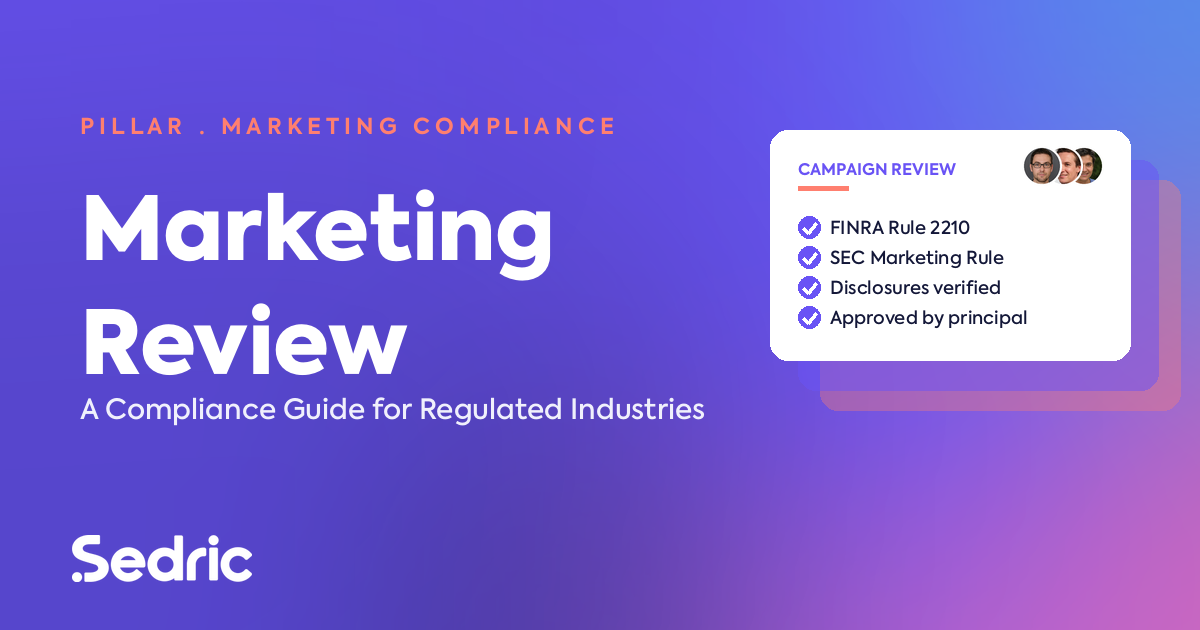
A marketing review is the structured, documented process of evaluating customer-facing content — advertisements, emails, social posts, websites, sales scripts, brochures, finfluencer videos — for compliance with applicable laws, regulations, and internal policy before that content is published. In regulated industries, it is not an optional creative-services step. It is the firm’s primary defense against misleading-advertising enforcement, consumer-protection actions, and reputational damage.
If you are a compliance officer, a marketing leader, or a CMO operating in financial services, insurance, banking, healthcare, or any consumer-facing regulated sector, the way you run your marketing review program directly determines two things: how fast you can launch campaigns, and how exposed you are when a regulator comes knocking. This guide walks through what a marketing review actually is, the regulatory frameworks that govern it across industries, what a modern review workflow looks like end-to-end, the most common pitfalls that draw enforcement, and how AI is reshaping the discipline in 2026.
A marketing review is the pre-publication compliance and legal vetting of any communication a regulated business intends to put in front of customers, prospects, or the public. The scope is wider than most people assume. It covers paid ads, organic social posts, landing pages, blog articles, podcast scripts, video creative, sales-team talking points, customer emails, push notifications, app store screenshots, partner co-marketing assets, and increasingly content produced by influencers and creators on the firm’s behalf.
The review answers a simple question: would a regulator, an investor, or a customer find this material fair, balanced, accurate, and not misleading? In practice, that question requires checking dozens of specific things — required disclosures, prohibited claims, performance presentation rules, recordkeeping flags, fair-lending implications, accessibility, and more — depending on the industry and jurisdiction.
A well-run marketing review program produces three deliverables on every piece of content: a clear approve / revise / reject decision, an audit trail showing who reviewed what and when, and an archived copy of the final approved version. Without all three, a firm is exposed even on materials that happen to be perfectly compliant.
Regulators across jurisdictions have made advertising and promotional content one of the most active enforcement areas of the past five years. The reason is simple: marketing materials are public, easy to monitor at scale, and they are often the first place a firm’s sales practices break down.
A few illustrative examples from recent enforcement waves:
The numbers tell a consistent story. Marketing review is no longer a back-office compliance task; it is a front-line operational risk function. Firms that treat it as a checkbox exercise routinely pay seven-figure fines and absorb collateral damage that, by some industry estimates, can run nine times larger than the headline penalty in stock-price terms alone.
Any business whose marketing is governed by sector-specific advertising rules needs a formal marketing review program. That includes, at minimum:
If your firm sits in any of these categories, every customer-facing asset belongs in a marketing review pipeline.
Marketing review obligations look different in each sector, but the pattern across them is remarkably consistent: a written supervisory procedure, principal pre-approval, content-level testing for fairness and balance, mandated disclosures, recordkeeping, and post-publication monitoring. Below is a working map of the frameworks that drive most U.S. and UK reviews today.
FINRA Rule 2210 is the cornerstone advertising rule for U.S. broker-dealers. It classifies every communication into one of three buckets — retail communications, correspondence, and institutional communications — and applies different supervisory requirements to each. Retail communications generally require principal approval before first use. Certain categories (such as those concerning registered investment companies, options, or bond mutual fund volatility ratings) must also be filed with FINRA’s Advertising Regulation Department, often before first use.
Rule 2210 sets the substantive bar as well: communications must be fair and balanced, must provide a sound basis for evaluating the facts about any product or service, and must not omit any material fact whose absence would render the communication misleading. Predictions, exaggerated claims, and selective performance presentations are explicit triggers. Recordkeeping for at least three years from last use (with the first two years readily accessible) is required by SEA Rule 17a-4 and incorporated by reference into FINRA’s framework. For deeper detail on the rule’s practical application, see Sedric’s guide on what CMOs need to know about SEC and FINRA ad rules.
The SEC’s amended Marketing Rule consolidated and modernized the old advertising and cash-solicitation rules for registered investment advisers. It introduced a principles-based prohibition on seven categories of false or misleading content, established detailed conditions for using testimonials and endorsements, codified rules for the use of third-party ratings, and set strict requirements for performance advertising — particularly for hypothetical, predecessor, and gross-versus-net performance presentations. Marketing review for an RIA must include a substantive policy step that confirms each advertisement complies with all seven prohibitions and that any performance disclosure satisfies the rule’s conditions.
For banks, fintechs, and lenders, the dominant framework is UDAAP — the prohibition on unfair, deceptive, or abusive acts or practices under Dodd-Frank Section 1031 and the FTC Act Section 5. UDAAP is principle-based and intentionally broad, which means a marketing review must look beyond the literal accuracy of a claim and ask whether a reasonable consumer would be likely to be misled, harmed, or steered into an unfavorable outcome. Layered on top are product-specific rules: TILA / Regulation Z for credit advertising (including triggering-term rules), RESPA for mortgage marketing, the SAFE Act for mortgage-loan-originator marketing, and fair-lending considerations under ECOA and the Fair Housing Act. For a deeper treatment, see Sedric’s analysis of how AI can help tame UDAAP risk.
Insurance marketing in the U.S. is regulated primarily at the state level, but most states adopt some version of the NAIC’s Advertisements of Life Insurance and Annuities Model Regulation and the parallel Health Insurance model. Both impose substantive content rules — prohibitions on misleading statistics, mandatory disclosure of material limitations, restrictions on the use of terms like “investment” or “deposit,” and required identification of the insurer. Some states require carriers to maintain an advertising file, certify compliance during market-conduct exams, and pre-file certain advertisements. A marketing review program for an insurance carrier or distributor must therefore handle both the federal-style content review and a 50-state matrix of jurisdictional variations.
For prescription drug, medical device, and health-claim advertising, the FDA Office of Prescription Drug Promotion (OPDP) governs the substantive rules: balanced presentation of risks and benefits, accurate indications, fair-balance disclosure, and appropriate audience targeting. Direct-to-consumer drug ads carry particularly strict requirements. Outside FDA-regulated products, the FTC enforces general truth-in-advertising rules with a heavy emphasis on substantiation of health and wellness claims. Marketing review in this space is necessarily evidence-driven — every claim must be tied to a documented basis.
In the UK, the FCA’s financial-promotions regime under section 21 of FSMA prohibits a person from communicating an invitation or inducement to engage in investment activity unless approved by an authorized person or exempt. The FCA’s rules on financial promotions are spelled out across the Conduct of Business Sourcebook (COBS), the Banking Conduct of Business Sourcebook (BCOBS), and the Insurance Conduct of Business Sourcebook (ICOBS). Layered on top, the Consumer Duty (in force since July 2023) requires firms to act to deliver good outcomes for retail customers — including in their communications, which must be timely, clear, and capable of being understood. MiFID II adds further marketing-communication requirements for in-scope investment firms across the EU.
Even outside vertical-specific frameworks, every regulated marketer must layer in horizontal rules: FTC endorsement guidelines (including disclosure of material connections with influencers), CAN-SPAM, the Telephone Consumer Protection Act, the EU GDPR and UK GDPR for data-driven targeting, ePrivacy rules for cookies and tracking, ADA / WCAG accessibility considerations for digital content, and the rapidly evolving state privacy law landscape (CCPA/CPRA, plus the parallel laws in Virginia, Colorado, Connecticut, Utah, Texas, and others).
A defensible marketing review program is not just a Slack channel and a goodwill agreement between marketing and compliance. It is a documented workflow with explicit stages, role assignments, decision criteria, and recordkeeping. The shape of that workflow is broadly the same across industries, even when the underlying rules differ.
Every piece of content enters the workflow through a single intake mechanism. At intake, the asset is classified by type (retail communication, correspondence, institutional, advertisement, sales literature, social post, etc.), by product line, by channel, by audience, and by jurisdiction. Classification drives every downstream decision — what rules apply, who has to approve it, whether it must be filed, and how long it must be retained.
Reviewers run the content against a defined checklist of substantive rules. In broker-dealer practice, that means Rule 2210 substantive standards plus any product-specific overlays (mutual fund performance, options disclosure, structured products, etc.). In banking, it means UDAAP analysis, fair-lending review, and TILA triggering-term checks. In insurance, it means NAIC content rules plus state-specific disclosures. The output is a redlined draft and a written rationale for any required changes.
Required disclosures are added or verified — risk disclosures, performance footnotes, sponsor identification, “past performance is not indicative of future results,” APR/APY mechanics, lender NMLS identifiers, FDIC-insurance status, regulatory disclaimers, and so on. This is the stage at which most quietly serious issues are caught: a disclosure that is technically present but typographically illegible, a footnote referenced but not actually included, a rate quoted without its required surrounding context.
Most regulatory frameworks require approval by a designated, qualified individual — a registered principal in broker-dealer practice, a designated compliance officer in RIA practice, an officer in some state insurance regimes. The approval must be documented, not implied.
Some communications require pre-use or post-use filing with a regulator — FINRA’s Advertising Regulation Department, certain state DOIs, the FCA in some scenarios. The workflow tracks which assets require filing, generates the submission package, and records the regulator’s response.
The approved version is the only version that goes live. The full record — the original draft, every revision, every reviewer comment, the approval signature, and the final published asset — is captured in a tamper-evident archive that satisfies the firm’s recordkeeping rule (commonly three to five years, sometimes longer).
Modern enforcement increasingly focuses on what happens after a campaign launches — what influencers actually said, how landing pages drifted from the approved version, what edits creators made on platforms the firm doesn’t fully control. Post-publication monitoring closes the loop with periodic sampling and, ideally, continuous content surveillance across owned and third-party channels.
For a granular walk-through of how to operationalize this end-to-end, Sedric’s playbook on building a marketing compliance review workflow that doesn’t kill growth covers the implementation details.
The same patterns turn up across enforcement actions year after year. Knowing them is half of avoiding them.
The hard part of marketing review is not running the workflow once. It is running it consistently, at the velocity modern marketing organizations operate at, across every channel and jurisdiction, without becoming the bottleneck that growth teams resent.
Several program-level decisions separate scalable programs from the ones that grind to a halt:
Centralized intake, decentralized creation. Marketers can create across dozens of tools — Canva, Figma, HubSpot, Google Docs, Adobe, video editors — but every asset enters one intake queue with consistent metadata. Without centralized intake, audit-trail gaps are guaranteed.
Tiered review by risk. Not every asset deserves the same scrutiny. A whitepaper aimed at institutional investors and a TikTok ad aimed at retail beginners need different review depth. Tiering by risk lets compliance focus its attention where the regulatory exposure actually is.
Codified guardrails. The rules that govern your industry should be encoded as a structured library — a watchlist of risky terms, required disclosures keyed to product and jurisdiction, prohibited claim categories, performance presentation templates. The library is the program’s memory.
Real-time, not retrospective, surveillance. Quarterly sampling catches problems months after they happened. Continuous content monitoring across approved channels, partner channels, and third-party creators catches them in days or hours.
Defensible recordkeeping by default. If recordkeeping is something an analyst has to remember to do at the end of a project, it will fail. The system should capture the record automatically as a byproduct of the workflow.
Metrics that matter. Average review turnaround time, rework rate, percentage of campaigns shipped on time, percentage of channels under continuous monitoring, time-to-archive, audit-readiness score. The program is only as good as the metrics it can show a regulator on a Tuesday morning.
Marketing review has historically been a human-bound process. A trained reviewer reads the asset, applies the rule, makes a call, writes a note. That model worked when marketing volume was measured in dozens of pieces a quarter. It does not scale to a world where a single firm produces thousands of social posts, hundreds of paid ads, dozens of landing-page variants, and a long tail of influencer content every month — across every regulated jurisdiction it operates in.
AI is reshaping the discipline in three concrete ways. First, large language models can parse marketing content the way a reviewer does — flagging promissory language, missing disclosures, off-policy claims, and prohibited terms — at a speed and consistency human reviewers cannot match. Second, AI can codify a firm’s policy library and apply it deterministically: every reviewer applies the same standard to the same content the same way, every time, with the explanation captured for audit. Third, AI enables continuous surveillance — scanning approved channels, partner channels, and influencer feeds in near real time and flagging drift the moment it appears.
The risk is also real: an AI system trained or deployed carelessly can introduce new UDAAP, fair-lending, or accessibility issues of its own, and regulators have made clear they expect firms to govern AI tooling with the same rigor they apply to any other compliance control. The bar is human-in-the-loop oversight, model documentation, bias monitoring, explainability of every flag, and continuous validation.
Used well, AI takes marketing review from the bottleneck stage of the campaign lifecycle to the stage that quietly enables everything else. Used carelessly, it just creates a faster way to ship the same problems.
Sedric is an AI compliance platform built specifically for regulated marketing. Its marketing compliance product sits across the workflow described above — pre-publication review, principal approval, recordkeeping, and post-publication monitoring — and applies a regulator-tuned policy engine to every asset. The platform encodes the relevant frameworks (FINRA Rule 2210, the SEC Marketing Rule, CFPB UDAAP standards, NAIC content rules, FCA financial promotions, MiFID II, and the firm’s own internal policies) as a structured rule library, runs every asset against that library, and produces an explainable, auditable decision with a complete record of the inputs.
In practice, that means marketing teams get content cleared in minutes rather than days, compliance teams shift from manual reading to managing exceptions, and the firm walks into any regulator exam with a complete, queryable archive of what was reviewed, who approved it, and what was published. Sedric’s broader compliance platform extends the same approach to call recordings, email surveillance, social posts, and finfluencer content — the channels where most of the recent enforcement action has actually occurred. Firms can read more about the underlying AI Reviewer for a closer look at how the policy engine works.
The point is not that AI replaces the principal, the compliance officer, or the in-house counsel. It does not, and regulators do not expect it to. The point is that a modern marketing review program treats human judgment as the scarce resource and uses AI to apply that judgment consistently across a much larger volume of content than any team could review by hand.
A marketing review in compliance is the documented, pre-publication evaluation of customer-facing content against applicable laws, regulations, and internal policies. In regulated industries, it typically involves classification, content review, disclosure verification, principal approval, regulatory filing where required, archiving, and post-publication monitoring.
In practice the terms are used interchangeably. “Marketing review” is the broader operational process, which always includes a compliance dimension in regulated industries. “Marketing compliance review” emphasizes the regulatory check specifically. Either way, the workflow and obligations are the same.
Responsibility is shared. Marketing creates the content. Compliance, supervised by a Chief Compliance Officer or designated principal, reviews and approves it. Legal weighs in on contractual or claims-substantiation questions. The principal’s sign-off is the act that satisfies the rule in most broker-dealer and adviser contexts.
In manual programs, anywhere from two days to three weeks depending on asset complexity, jurisdiction, and team workload. AI-assisted programs routinely cut that to minutes for low-risk assets and hours for high-risk ones, with human reviewers focused on exceptions.
At minimum: the original asset, every revision, every reviewer comment, the approval signature, the final published version, and the dates and identities associated with each. Retention periods vary — three years from last use under SEA Rule 17a-4 / FINRA Rule 2210 for broker-dealers, five years for SEC-registered advisers under Rule 204-2, and longer in some state insurance regimes.
Yes. FINRA Regulatory Notices 10-06, 11-39, and 17-18, the SEC Marketing Rule, and the FTC endorsement guidelines all extend to social posts, influencer content, and content posted by employees on the firm’s behalf. Recent enforcement (M1 Finance, Public.com, Moomoo, TradeZero) makes clear that firms are responsible for what their paid creators say.
No, and regulators are clear on this point. AI can dramatically accelerate the review and apply policy more consistently than humans, but human-in-the-loop oversight, principal approval where required, model governance, and explainability are non-negotiable. AI is the analyst; the principal is still the principal.
A marketing review program is, in the end, the firm’s answer to a single question every regulator asks: show us how you make sure your customers are not misled. The firms that answer that question well are the ones that have a documented workflow, a codified policy library, a defensible record of every decision, and the technology to apply that machinery at the speed of modern marketing. The firms that answer it badly are the ones that pay seven figures to find out their process did not scale. Marketing review is not glamorous, but in regulated industries it is the difference between launching campaigns and explaining campaigns. The discipline is worth getting right.

Convert your static procedures into active AI controllers that protect your brand 24/7.




.svg)

Scale marketing compliance without slowing down.