
Share article on


.svg)


Debt collection compliance software is purpose-built technology that monitors, scores, and documents every call, letter, SMS, and email a collection operation produces, measured in real time against the federal, state, and client-level rules that govern collections. This guide covers what the category does, which rules it has to handle, where legacy call-monitoring tools fall short, and the capabilities ARM leaders evaluate when they shortlist a platform.
Debt collection compliance software replaces the sampling-based QA model most ARM operations inherited. Instead of reviewers listening to a 2–5% sample of calls days after the fact, a modern platform transcribes and scores 100% of calls within minutes, flags findings grounded in a specific rule or policy, and keeps the audit trail an examiner expects to see.
The category has two closely related names — debt collection compliance software and ARM compliance software. The underlying product is the same: a review-and-evidence layer that sits across every outbound channel an ARM operation uses, applies a jurisdiction-aware policy library, and produces findings a regulator or client can audit.
Three characteristics define the category and separate it from the call-recording and dialer tools that preceded it:
Three forces have pushed debt collection compliance software from a nice-to-have to a board-level priority.
Regulatory enforcement has escalated. The CFPB, the FTC, state attorneys general, and the FCA (for UK operations) have all raised the bar on what counts as a compliant collections programme. The FTC's permanent bans in debt-collection enforcement cases and the CFPB's ongoing UDAAP focus mean that the "we reviewed 3% and found nothing" defence is gone. Sampling is no longer sufficient on its own for consumer-financial calls in regulated contexts.
Call volume has outpaced headcount. ARM teams are running more accounts per collector than ever, with multi-channel outreach (voice, SMS, email, chat) layered on top. Reviewer capacity hasn't grown linearly. The gap between what gets reviewed and what gets published is where enforcement findings live.
Clients and creditors are enforcing continuous monitoring. Creditors who place accounts, debt buyers who sell them, and BaaS banks whose fintech partners run collections all now require continuous evidence that the collection operation is compliant — not an annual audit, not a sample. That's a contractual, not just a regulatory, driver.
Modern debt collection compliance software covers substantially more than a call-recording archive. The review surface for a mature programme includes:
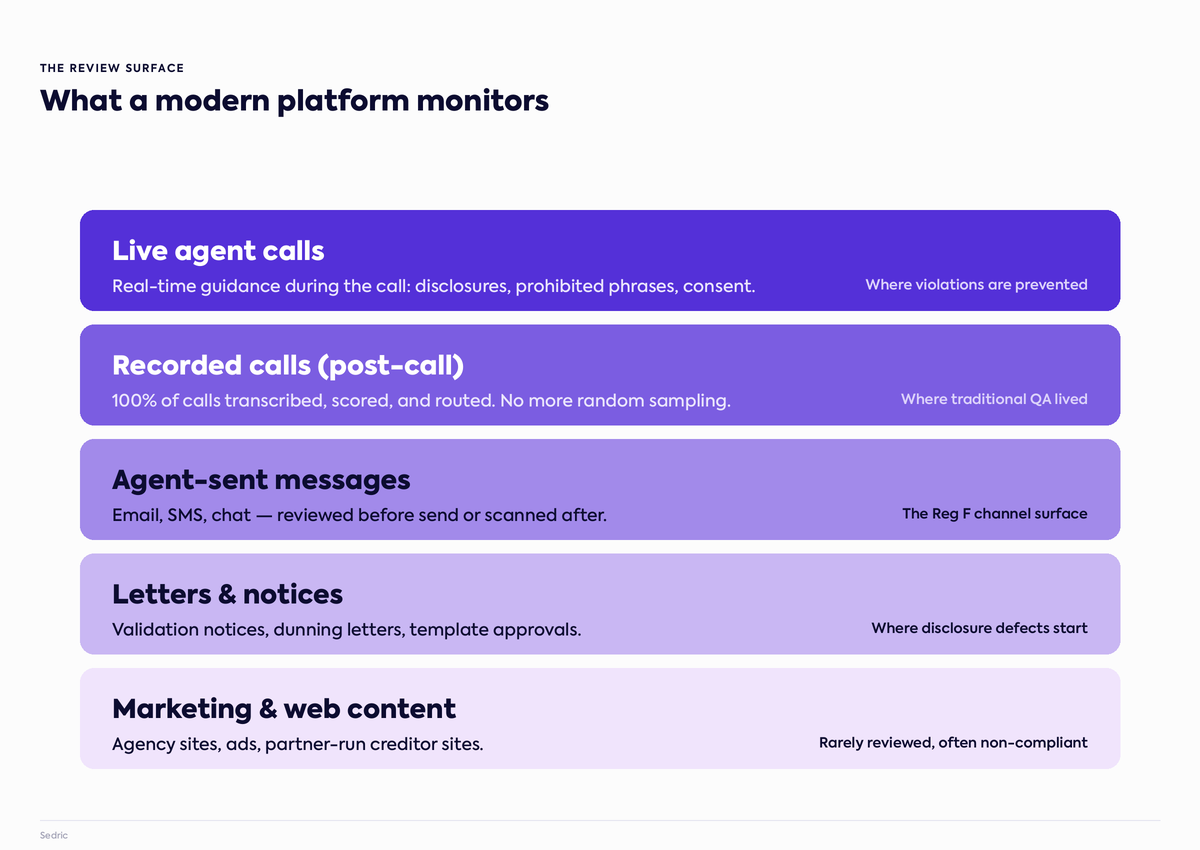
The common denominator is that each of these is an outbound communication a regulator or client auditor can read as representing the collection operation. The compliance surface therefore matches the distribution surface.
Debt collection compliance software is only as good as the policy library behind it. In the US, the stack is layered and overlapping; UK and EU operations layer on their own frameworks.
Licensing, calling-hour overlays, state UDAP statutes, state collection practices acts (California Rosenthal Act, Florida Consumer Collection Practices Act, New York collector licensing, Texas debt-collector registration, among others), state-level call-recording consent laws (one-party vs two-party), and time-barred-debt disclosure requirements. Multi-state operations are typically subject to several of these at once, which is why state-aware policy libraries are a buying criterion.
A platform that treats the UK or EU as thin overlays on a US library won't survive an FCA review. Jurisdictional depth is one of the first filters serious buyers apply.
The call-monitoring model most ARM operations inherited was designed for a regulatory world where quarterly sampling was defensible. Three breakages are consistent across firms:

Sampling misses what matters. At 2–5% coverage, the calls that cause enforcement findings are statistically likely to go unreviewed. Regulators have signalled they expect more; clients and creditors increasingly require it in contract.
Keyword spotting generates noise and misses signal. Legacy speech-analytics engines flag calls on literal phrase matches, which produces high false-positive rates and misses paraphrased violations entirely. A collector who paraphrases a disclosure doesn't trip a keyword; the violation still happens.
Post-hoc review doesn't prevent violations. By the time a sampling-based review catches a problem, the harm is done and the complaint window is open. Real-time guidance during the call changes the shape of the risk curve, not just the reporting.
The structural answer isn't more reviewers. It is a shift from manual, sample-based QA to continuous, policy-driven review with real-time guidance and human judgement reserved for the cases that need it.
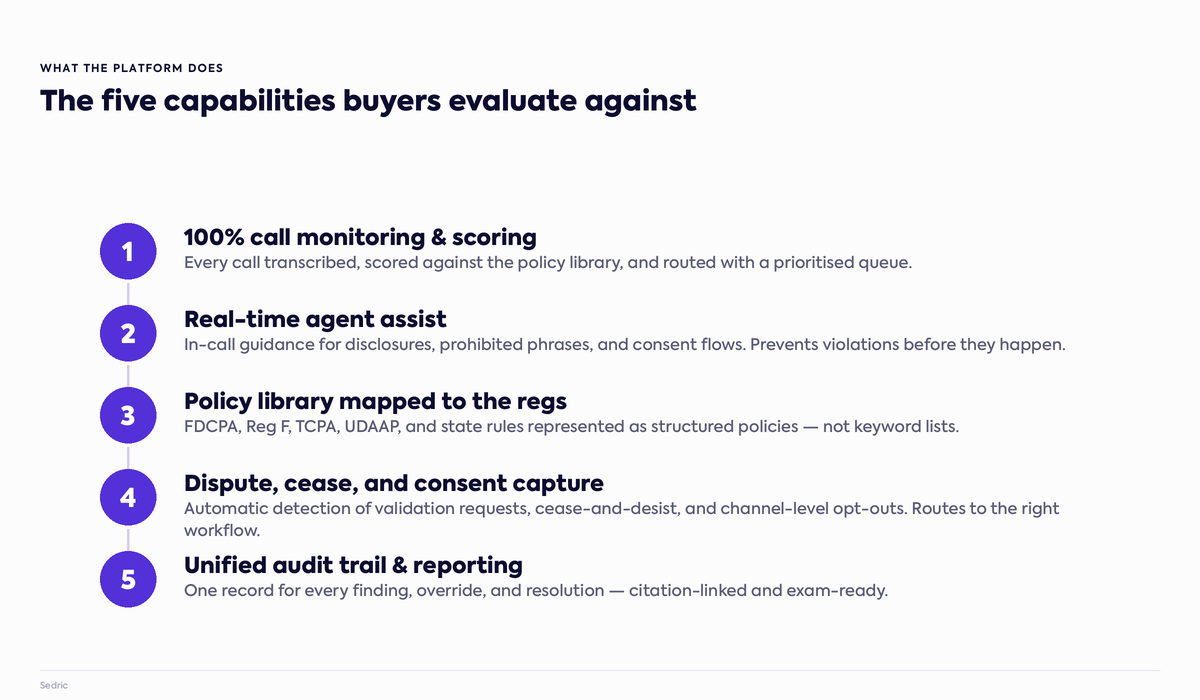
Across the shortlists we see ARM leaders run, the evaluation criteria converge on five capabilities. A serious platform does all five; a tool that does one of them well isn't a compliance platform.
Buyers often start by looking at tools in neighbouring categories. Each is useful for a different problem; none is a substitute for a debt collection compliance platform.
A debt collection compliance platform sits across the archive and the dialer, reads the call and the message, applies the policy library, and produces the audit trail. See the 2026 Buyer's Guide for a longer-form evaluation framework.
Six buyer segments, same category:

A credible deployment is measured in weeks, not quarters. The typical ARM deployment runs on a crawl-walk-run track:
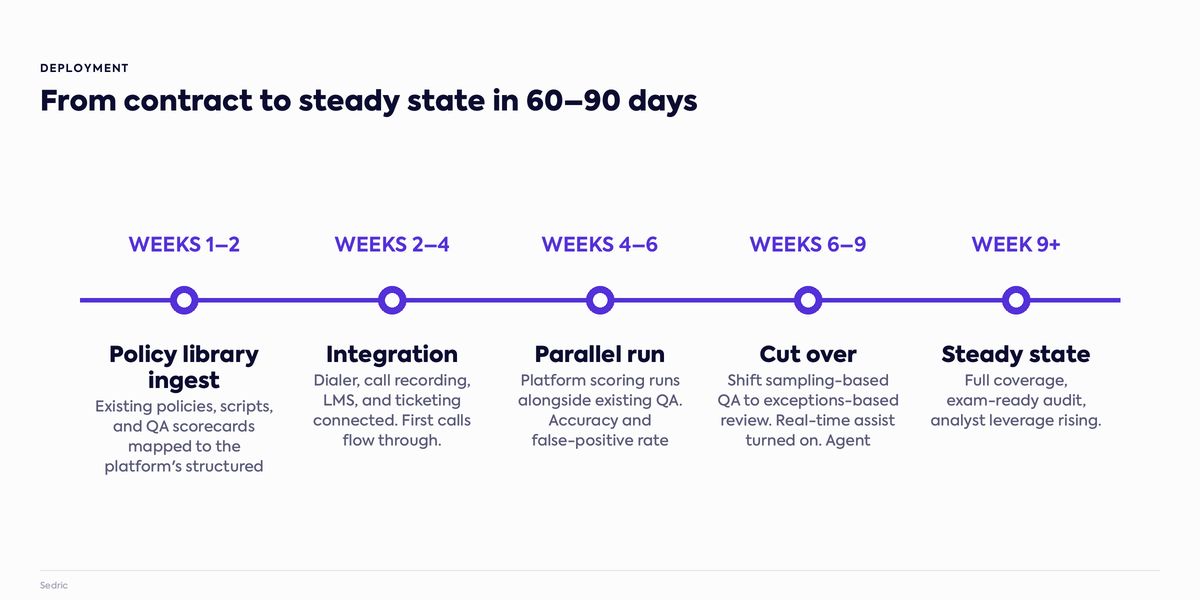
Deployments that stretch past 120 days are usually a sign of a thin policy library (every state and rule being hand-built in-flight) or missing integrations.
The ROI model ARM buyers run is consistent across segments. Six metrics matter:
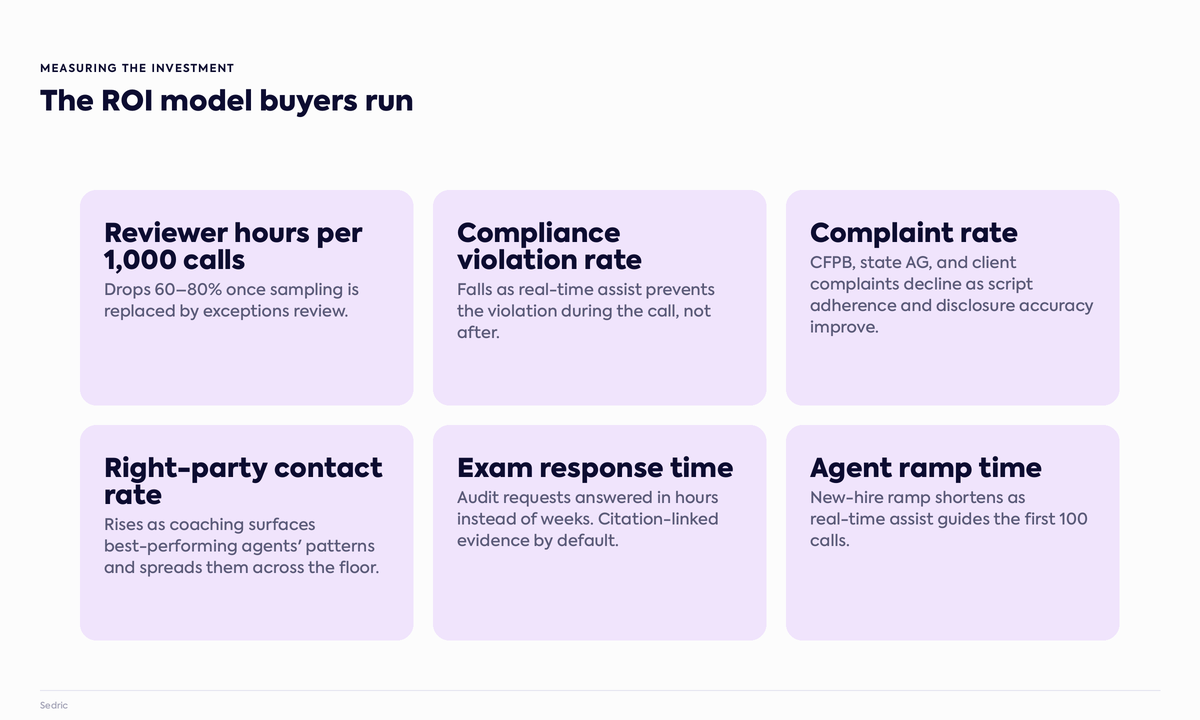
A compressed version of the longer Buyer's Guide:
Sedric is built for this category. The platform covers 100% of calls, SMS, email, and letters through a single policy library that maps to FDCPA, Reg F, TCPA, UDAAP, FCRA, FCA CONC, and state collection and licensing rules. Findings are grounded in the specific rule they're raised under. Real-time agent assist prevents violations during the call; post-call review runs continuously on the other side.
For ARM leaders evaluating the category, Sedric publishes a comparison hub at best debt collection compliance software, and head-to-head pages against Prodigal, CallMiner, and the other platforms buyers typically shortlist.
No. Speech analytics is a 2010s-era category of keyword-spotting tools that generate flags from literal phrase matches. Debt collection compliance software is a 2026-era category of policy-driven, LLM-based platforms that read calls in context, cite the specific rule a finding was raised under, and provide real-time guidance during the call.
No. Dialers enforce call-frequency presumptions and hours-of-day rules at the dial layer. A compliance platform sits downstream of the dialer and reviews what the agent actually says once connected. The two integrate.
Modern platforms cover the full Reg F channel surface, including limited-content voicemails, SMS opt-out handling, and electronic-communication disclosure rules. Voice-only tools miss this.
Yes. Multi-state policy libraries and per-client scoring are standard features for platforms built for the ARM market. Platforms adapted from general CX AI typically do not do either well.
60–90 days for a single-brand collection operation; 90–120 days for multi-client BPO or multi-jurisdiction. Deployments that stretch past that are usually a sign of a thin policy library.
Typically per-seat or per-minute of monitored audio, with policy-library tier adjustments for multi-state and international coverage. Budget by call volume rather than headcount for an accurate comparison.
Dialer (Genesys, Five9, LiveVox, NICE CXone, Convoso, TCN), call recording (Verint, NICE, Calabrio), LMS, ticketing (Zendesk, ServiceNow), and the collection system of record. Serious platforms publish their integration catalogue; thin platforms list "APIs available."
The buyer's test for debt collection compliance software is simple: run the platform against your real calls, letters, and messages, and see whether the findings are grounded in the rules you actually operate under. Sedric runs a 30-minute working session using your own content. We'll show the findings, the citations, and the audit export in that session.
Convert your static procedures into active AI controllers that protect your brand 24/7.



.svg)
.avif)
You’ll be able to see a full demo of marketing and communications compliance with your brand.
![Featured image for 'AI in Debt Collection Compliance: How Agent-Assist Changes the Operating Model' — Sedric branded [sedric-rebrand-v2]](https://cdn.prod.website-files.com/69a7e1717e5289161221dbf3/6a15f17925f21ab4460678fd_6a15f176bd2ec6cdff9602e1_featured-rebrand-ai-debt-collection-compliance-2026.png)
![Featured image for 'State Debt Collection Laws 2026: A Practitioner's Map' — Sedric branded [sedric-rebrand-v2]](https://cdn.prod.website-files.com/69a7e1717e5289161221dbf3/6a15f17ebc29bfe311dd0d28_6a15f17b18c1990398b7991f_featured-rebrand-state-debt-collection-laws-2026-practitioners-map.png)
![Featured image for 'CFPB Reg F: The 2026 Operator's Guide' — Sedric branded [sedric-rebrand-v2]](https://cdn.prod.website-files.com/69a7e1717e5289161221dbf3/6a15f184b9e16b2074c63303_6a15f180de817f5765d9678b_featured-rebrand-cfpb-reg-f-2026-operators-guide.png)