Debt collection compliance software is the
operational system that lets a creditor, debt buyer, or third-party collection
agency monitor every customer-facing conversation — calls, chat, email,
texts, dialler campaigns — for compliance with the FDCPA, CFPB Reg F, and the
patchwork of state debt-collection laws, in real time, at 100% coverage. In
2026 the category is no longer optional for any operator with material call
volume: the CFPB's 2024-2025 supervisory cadence, the state attorneys-general
sweeps, and the rise of consumer-protection class actions have made retrospective
sampling untenable. This guide sets out what the software should do, build vs
buy, evaluation criteria, vendor archetypes, and where Sedric fits as the
AI-native option.
Why Debt Collection Compliance Software Matters in 2026
The economics of debt-collection compliance have shifted. A decade ago, a
QA team sampled 1-2% of calls, generated monthly scorecards, and called it
oversight. That model fails 2026 supervision for three reasons:
CFPB Reg F changed the game. Since November 2021, Reg F
codifies prescriptive rules on call frequency (the 7-in-7 rule), validation
notice content, communications media restrictions, and recordkeeping.
Compliance is rule-mapped and testable — exactly what Reg F examiners
ask for.
State AG enforcement is escalating. California, New York,
Massachusetts, Illinois, Texas, Washington — multiple state AGs have brought
significant debt-collection actions in 2024-2025. Each state's rules differ;
operating without state-aware compliance creates exposure across the
collection-jurisdiction footprint.
Consumer plaintiffs' bar has gone digital. Class-action
firms now use call-recording transcripts as evidence. A single mishandled
call surfacing in discovery can cascade into a class.
The operational answer is software that monitors 100% of communications
in real time, flags violations against rule, captures evidence of the firm's
corrective action, and produces the artefact base supervisors expect.
What Debt Collection Compliance Software Should Do
A 2026-grade platform covers, at minimum, the following capabilities:
Real-time call monitoring. 100% of outbound and inbound
collection calls captured, transcribed, and scored against FDCPA / Reg F /
state-law rule library — live, while the agent is still on the line.
Agent-assist surfacing. The platform whispers the
required disclosure (mini-Miranda, debt validation, call-frequency caution)
to the agent at the right moment, reducing accidental violations.
Post-call QA at scale. Automated 100% sample of completed
calls, scored against the firm's policy library and the rulebook.
Communications-media coverage. Calls, SMS, email,
chat, and any consumer-facing portal interaction — all monitored, all
audit-trailed.
Dialler integration. Pre-call enforcement of Reg F
call-frequency limits, time-of-day rules, do-not-call lists, and consumer
opt-outs.
Validation notice management. Workflow to generate, send,
and track the Reg F validation notice within the 5-day window, with consumer
response handling.
Complaint root-cause analysis. Complaints by AR, by
campaign, by agent — root-cause patterns surfaced from the underlying call
data.
Recordkeeping. Every call, every notice, every consumer
interaction retained for the rule-required retention period (typically 3
years under Reg F § 1006.100), in an FCRA-aligned audit-trail format.
State-law overlay. Per-state license tracking, disclosure
mandates, communication restrictions, calling-hour rules, debt-validation
deadlines — all encoded as a rule library.
A platform covering all ten is rare. Most buyers end up combining a
purpose-built compliance platform (capabilities 1-4, 8-10) with their
existing dialler / CRM (5-7).
Build vs Buy
In 2026 the build path for collections compliance is closed for any
operator not running a multi-hundred-million-dollar book. The reasons:
The AI capability is hard. Speech-to-text plus
compliance-aware natural-language processing requires a fine-tuned model
stack, regulator-aware language models, and continuous evaluation against
new enforcement themes. Not a build-it-yourself project.
The rule library is wide. FDCPA, Reg F, the 50-state
patchwork, evolving CFPB guidance, FTC Holder Rule, TCPA, GLBA, and the
FCRA all overlap on debt-collection conduct. Encoding the rulebook
correctly is a vendor specialty.
Volume drives economics. Vendors operating across many
clients realise economies of scale (model improvement, regulatory updates,
shared compliance intelligence) that no single firm can match in-house.
The decision is rarely whether to buy — it's which vendor archetype to buy.
Vendor Archetypes in the Category
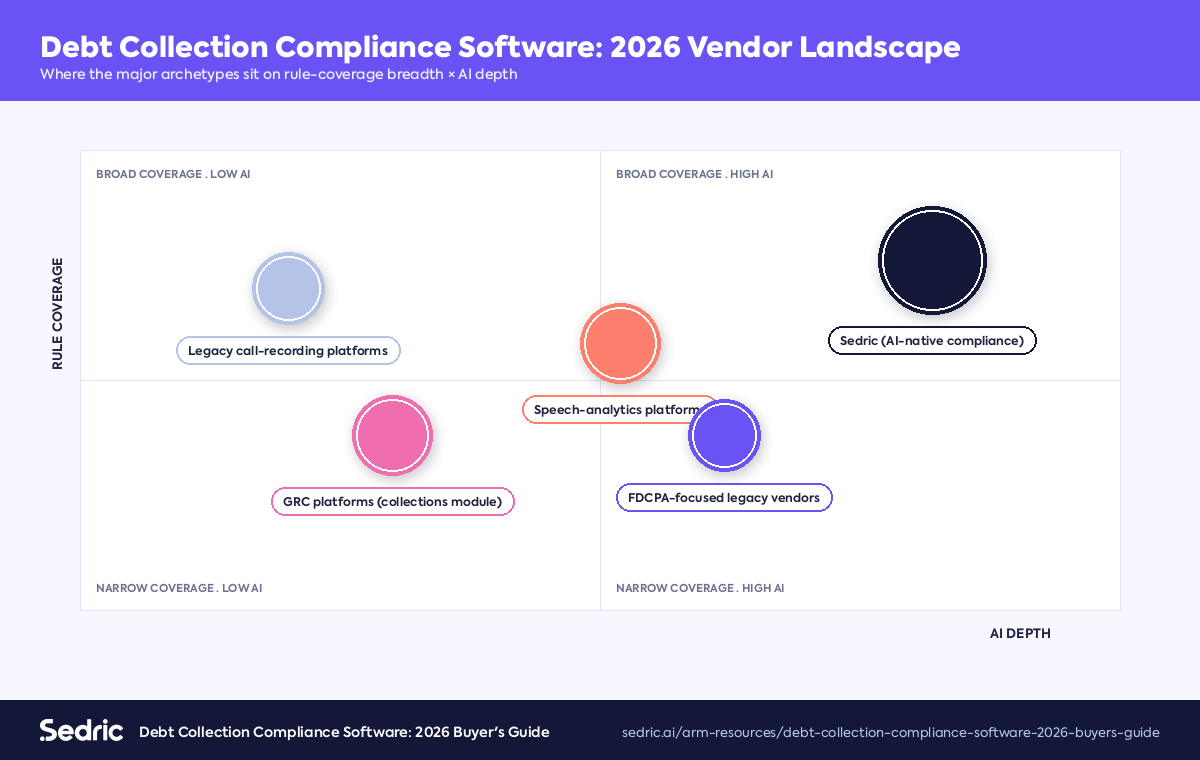
Legacy call-recording platforms. Strong on capture +
retention. Weaker on real-time scoring, AI-native rule mapping, and rule
library breadth.
Speech-analytics platforms. Strong on post-call QA at
scale. Variable on real-time, on Reg F-specific rule encoding, and on
state-law overlay.
GRC platforms with debt-collection modules. Strong on
policy management and case workflow. Weaker on the operational call
monitoring that is the heart of the discipline.
AI-native compliance platforms. Strong on real-time
scoring, rule-mapped flags, agent-assist, and continuous improvement.
Sedric sits in this category — built on the industry's first
compliance-dedicated LLM.
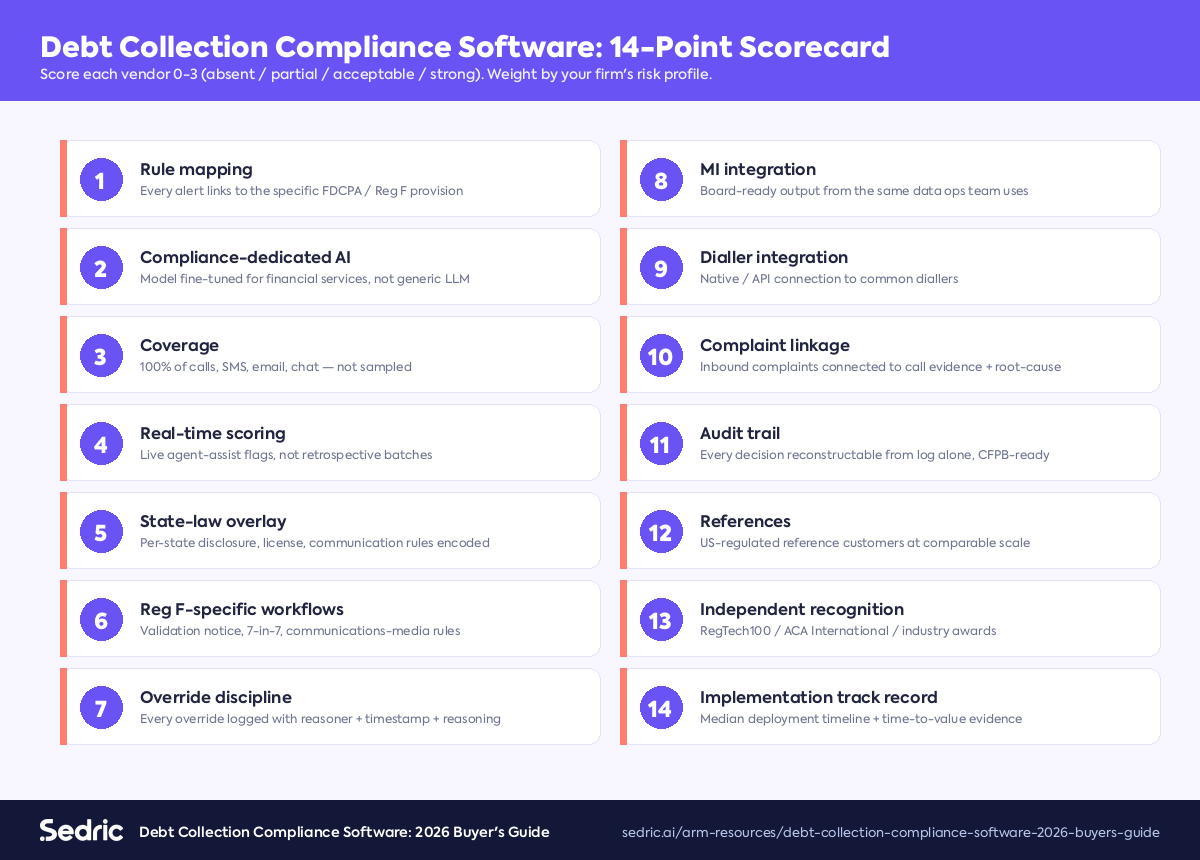
The 14-Point Evaluation Scorecard
Score each vendor 0-3 (absent / partial / acceptable / strong). Weight by
your firm's specific risk profile.
Rule mapping. Does every alert link to the specific
FDCPA / Reg F / state-law provision it engages?
Compliance-dedicated AI. Models fine-tuned for financial
services compliance, or general-purpose LLM with prompt engineering?
Coverage. 100% of calls, SMS, email, and chat — or
sampled?
Real-time scoring. Live flags surfaced to the agent, or
batch-processed retrospectively?
State-law overlay. Per-state disclosure, license, and
communication restrictions encoded — or generic federal-only logic?
Override discipline. Every alert override logged with
reasoner identity, timestamp, and reasoning?
MI integration. Board-ready outputs from the same data
the operational team uses?
Dialler integration. Native or API-based connection
to common diallers (Five9, NICE, Genesys, Aspect, etc.)?
Complaint linkage. Inbound complaints connected to
underlying call evidence, with root-cause analysis?
Audit trail. Every decision reconstructable from log
alone, ready for CFPB exam delivery?
References. UK-regulated and US-regulated reference
customers at comparable scale, in your sector (creditor / debt buyer /
agency / first-party servicer)?
Independent recognition. RegTech100, ACA International,
or comparable industry recognition? Backed by reputable institutional
investors?
Implementation track record. Median deployment timeline,
references that confirm time-to-value?
How Sedric Helps
Sedric is built on the industry's first compliance-dedicated large
language model. The platform monitors 100% of collection-call conversations
in real time, scoring each call against the firm's policy library, the FDCPA,
CFPB Reg F, and the relevant state-law overlays. Every alert is rule-mapped;
every override is logged with reasoning. The agent-assist surface whispers
required disclosures, called-frequency cautions, and consumer-rights language
to the agent at the right moment.
Sedric customers include large-scale creditors, debt buyers, banks, and
specialty consumer-credit firms. The platform sits alongside the firm's
existing dialler, CRM, and complaints system — integrating through an
open API — rather than replacing them. The use-case Sedric is uniquely
well-suited to: monitoring what the collection floor is actually saying,
in real time, at 100% coverage, with rule-mapped output the firm can
defend in a CFPB examination.
FAQ
Is debt collection compliance software required by law?
No federal law mandates a specific software. The CFPB and state regulators
require that creditors and collection agencies maintain a Compliance
Management System adequate to the firm's risk profile. For any operator
above modest call volume, software is the only practical way to meet that
standard.
What's the difference between FDCPA software and Reg F software?
FDCPA is the statutory framework (1977). Reg F is the CFPB's implementing
regulation, in force since November 2021, that adds prescriptive operational
rules on call frequency, validation notice, communications media, and
recordkeeping. Modern software covers both.
How much does this typically cost?
Pricing varies widely. Per-seat models, per-call models, and platform
subscriptions are all common. Mid-market collection agencies typically
budget in the low-six-figure range annually; large creditors with high
call volume often invest seven figures.
How long does implementation take?
For most operators, 60-90 days to first production use. Dialler integration
is typically the longest pole.
What does the CFPB look for in a debt-collection software review?
Evidence that the firm's monitoring actually catches violations, that
the firm's response to flagged violations is timely, that the audit trail
is complete, and that the firm's Compliance Management System uses the
software's outputs to improve operations.
The Bottom Line
Debt collection compliance software is no longer a nice-to-have — it's
the operational backbone of a defensible compliance management system in
2026. The firms that handle it well have real-time visibility into 100% of
their customer-facing conversations, rule-mapped flagging tied to the
specific FDCPA / Reg F / state-law provision, and an audit trail that
survives CFPB examination on first request. Sedric is built for the firms
that intend to operate at that bar.
See Sedric in Action
Sedric's debt-collection compliance platform monitors 100% of your
collection calls, SMS, email, and chat conversations in real time, scores
each against the FDCPA, Reg F, and your state-law overlay, and produces
the audit trail the CFPB expects. Book a 30-minute
demo — we'll review a sample of your own calls, map findings to the
specific rule, and show what 100% coverage looks like end-to-end.


.svg)


![Featured image for 'Debt Collection Compliance Software: 2026 Buyer's Guide' — Sedric branded [sedric-rebrand-v2]](https://cdn.prod.website-files.com/69a7e1717e5289161221dbf3/6a15f190937c9f9185634d10_6a15f18c3e26f0692a237df5_featured-rebrand-debt-collection-compliance-software-2026-buyers-guide.png)



.svg)
.avif)
![Featured image for 'AI in Debt Collection Compliance: How Agent-Assist Changes the Operating Model' — Sedric branded [sedric-rebrand-v2]](https://cdn.prod.website-files.com/69a7e1717e5289161221dbf3/6a15f17925f21ab4460678fd_6a15f176bd2ec6cdff9602e1_featured-rebrand-ai-debt-collection-compliance-2026.png)
![Featured image for 'State Debt Collection Laws 2026: A Practitioner's Map' — Sedric branded [sedric-rebrand-v2]](https://cdn.prod.website-files.com/69a7e1717e5289161221dbf3/6a15f17ebc29bfe311dd0d28_6a15f17b18c1990398b7991f_featured-rebrand-state-debt-collection-laws-2026-practitioners-map.png)
![Featured image for 'CFPB Reg F: The 2026 Operator's Guide' — Sedric branded [sedric-rebrand-v2]](https://cdn.prod.website-files.com/69a7e1717e5289161221dbf3/6a15f184b9e16b2074c63303_6a15f180de817f5765d9678b_featured-rebrand-cfpb-reg-f-2026-operators-guide.png)