Share article on


.svg)


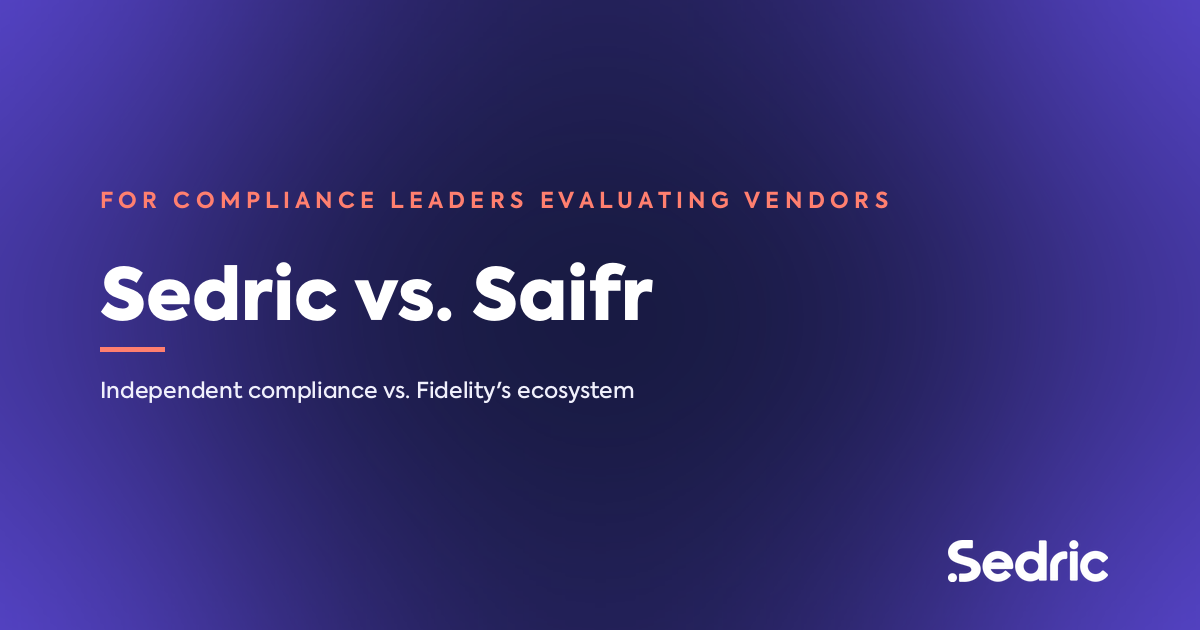
If you're evaluating Saifr — or already using SaifrReview or SaifrScan — this page is for you. Saifr is a RegTech incubated at Fidelity Labs (per saifr.ai). Their product suite (SaifrReview + SaifrScan) provides AI-driven detection for marketing content review, and their public materials cite regulatory coverage including FINRA 2210, SEC 482, and the SEC Marketing Rule.
This page explains the capabilities Sedric offers that drive switching decisions, the migration path, and the scenarios where Saifr is the right call.
1. Independence from any asset manager, wealth platform, or custodian. Saifr is a Fidelity Labs venture (per saifr.ai). Sedric is venture-backed and independent from any financial services firm. For firms whose competitive positioning against Fidelity matters at the multi-year contract level, independence removes a governance consideration.
2. Coverage beyond marketing content review. Sedric adds communications compliance, partner and affiliate monitoring, and live-agent assist under a single policy library and audit trail.
3. Cross-jurisdiction regulatory depth. Saifr's publicly stated regulatory focus is US (FINRA 2210, SEC 482, SEC Marketing Rule per saifr.ai). Sedric's library covers those, plus FCA COBS, MiCA, MiFID II, ESMA, NAIC, and CySEC. For firms with cross-border marketing, that breadth is often the deciding factor.
4. Embedded compliance in creator and AI-agent tools. Sedric's Figma plugin and Claude MCP connector bring compliance review directly into the tools where content is created.
5. Explicit citation grounding on every finding. Every Sedric flag is citation-linked to the specific policy, regulation, or brand rule that produced it. In an SEC exam, that traceability is what makes the finding defensible.
Every claim about Saifr on this page is sourced from Saifr's own public materials.
| Criterion | Saifr | Sedric |
|---|---|---|
| Corporate affiliation | Fidelity Labs venture (per saifr.ai) | Independent, venture-backed ($18.5M Series A) |
| Product suite stated publicly | SaifrReview and SaifrScan (per saifr.ai) | Marketing, communications, partner, live-agent — one engine |
| Regulatory frameworks stated publicly | FINRA 2210, SEC 482, SEC Marketing Rule (per saifr.ai) | FINRA, SEC, CFPB, FCA, MiCA, MiFID II, ESMA, NAIC, CySEC |
| Detection strengths stated publicly | Testimonials, comparison/ranking claims, performance claims, tax-free/exempt references, readability (per saifr.ai) | Full regulatory framework enforcement with citation-grounded findings |
| Platform integrations stated publicly | Microsoft Azure catalog (per Saifr press release, May 2024) | Figma plugin, Claude MCP connector, plus enterprise integrations |
| Security certifications publicly documented | See saifr.ai for current certifications | SOC 2 Type II, ISO 27001, PCI DSS |
If any row is inaccurate, contact us and we'll update within one business day.
Weeks 1–2: Historical audit data import + policy library port.
Weeks 2–6: Parallel run on your primary content workflow.
Weeks 6–8: Coverage expansion. Extend Sedric to communications, partner content, and agent-assist.
Weeks 8+: Cut-over decision.
Strategic independence. For firms whose competitive positioning against Fidelity matters at the multi-year contract level, moving compliance infrastructure off a Fidelity-affiliated vendor removes a consideration that compounds over the contract term.
Consolidated coverage. Consolidating into a marketing + communications + partner + agent platform typically cuts multi-vendor overhead and unifies the audit trail regulators recognise.
Regulatory jurisdiction expansion. Firms building EU, UK, or crypto marketing operations onto a US-focused compliance stack accumulate risk. Sedric's regulatory breadth is a hedge against that.
You're a traditional RIA or asset manager with deep operational ties to the Fidelity ecosystem. If your firm already runs on Fidelity's custody, clearing, or platform infrastructure, Saifr's institutional depth on that stack has real fit.
Your primary compliance need is testimonial / comparison / performance claim detection at high depth. Saifr publicly documents strong models on these specific areas.
You're US-only with no international expansion planned. Saifr's US regulatory focus matches that footprint.
Yes. Sedric's SEC Marketing Rule 206(4)-1 library specifically covers testimonial and endorsement disclosure conditions, performance-advertising standards (gross/net, prescribed time periods, hypothetical performance, related and extracted performance), and third-party rating conditions. See our SEC Marketing Rule guide for the depth of the framework.
Neither vendor publishes pricing on their site. Sedric is per-review-volume; ask us for a quote.
Yes. The 60-day parallel run is standard.
Sedric integrates with enterprise Azure environments via API and standard identity providers. Ask us for a technical walkthrough on your specific Azure footprint.
Book a 30-minute working session. We'll walk your compliance officer through Sedric on your actual content — testimonials, performance claims, third-party ratings, marketing communications — and show you what a citation-grounded, independent compliance stack looks like on your real work.
Facts about Saifr on this page are sourced from saifr.ai and public press coverage as of September 2026. If any claim is inaccurate, contact us at hello@sedric.ai and we'll update within one business day.

Convert your static procedures into active AI controllers that protect your brand 24/7.



.svg)

Scale marketing compliance without slowing down.