Share article on


.svg)


Content compliance is the discipline of making sure every piece of content a regulated organization publishes, sends, or sanctions is reviewed against the rules that govern it — before it goes live, while it's in-market, and in the archive an examiner will eventually ask to see. This guide covers what content compliance means in practice, which regulators care about it, where legacy review processes break under 2026 content volumes, and the operating model modern compliance teams are moving toward.
Content compliance refers to the review, approval, monitoring, and documentation of any outbound content a regulated firm produces or endorses, measured against both internal policy and external regulation. In financial services and other regulated industries, this includes marketing creative, customer communications, partner- and affiliate-produced content, agent-to-customer interactions on calls and chat, and increasingly, content generated or assisted by AI.
The core question content compliance answers is: does this message, in this channel, to this audience, in this jurisdiction, break any rule? That question used to be answered by a small team of reviewers reading campaigns before launch. Today it has to be answered continuously, at AI-era volumes, across a dozen channels, in real time.
Three characteristics separate content compliance from adjacent disciplines:
Three forces have made content compliance a boardroom-level priority in 2026.
Content volume has grown by an order of magnitude. Generative AI has pushed per-marketer content output from dozens of assets a quarter to hundreds a week. Partner ecosystems and affiliate programs multiply that further. Review capacity, meanwhile, has grown linearly if at all.
Regulators have escalated enforcement around content. In the US, the CFPB has prioritized UDAAP enforcement against misleading marketing, the FTC has stepped up influencer and endorsement actions, and FINRA and the SEC continue to issue significant fines over social media and communications supervision failures. In the UK, the FCA's Financial Promotions Gateway and Consumer Duty regime put content compliance at the center of supervisory expectations. In the EU, MiCA and MiFID II layer additional requirements for firms promoting investment and crypto products.
Content distribution has fractured. A single campaign now lives across email, paid social, affiliate blogs, SMS, in-app messaging, podcasts, and sometimes AI-chat surfaces — each with its own disclosure requirements, each a potential violation.
The gap between content velocity and compliance capacity is the structural problem content compliance exists to solve.
Content compliance covers substantially more than the campaign brief. For a regulated firm in 2026, the review surface typically includes:
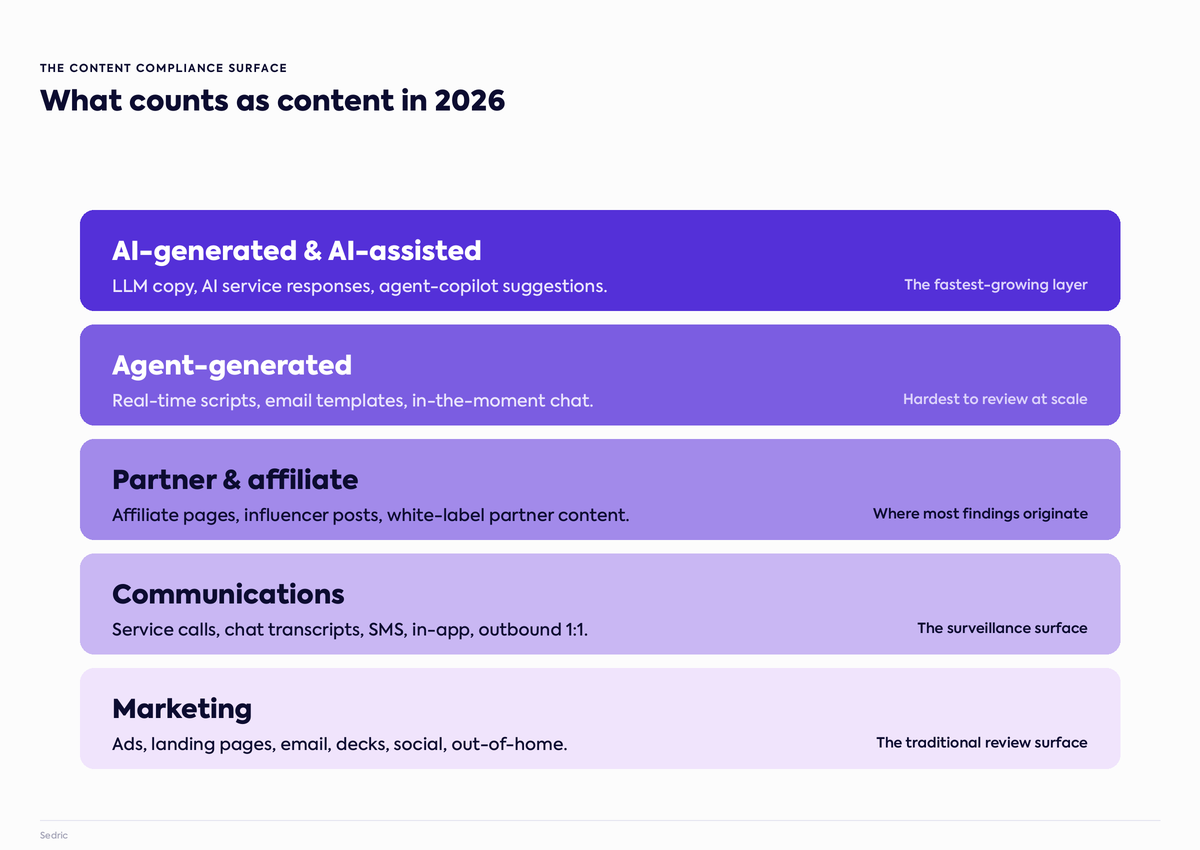
The common denominator is that each of these is an outbound communication a regulator could read as representing the firm. The compliance surface therefore matches the distribution surface.
Content compliance programs are built against overlapping stacks of regulation. The exact mix depends on jurisdiction, product, and audience.
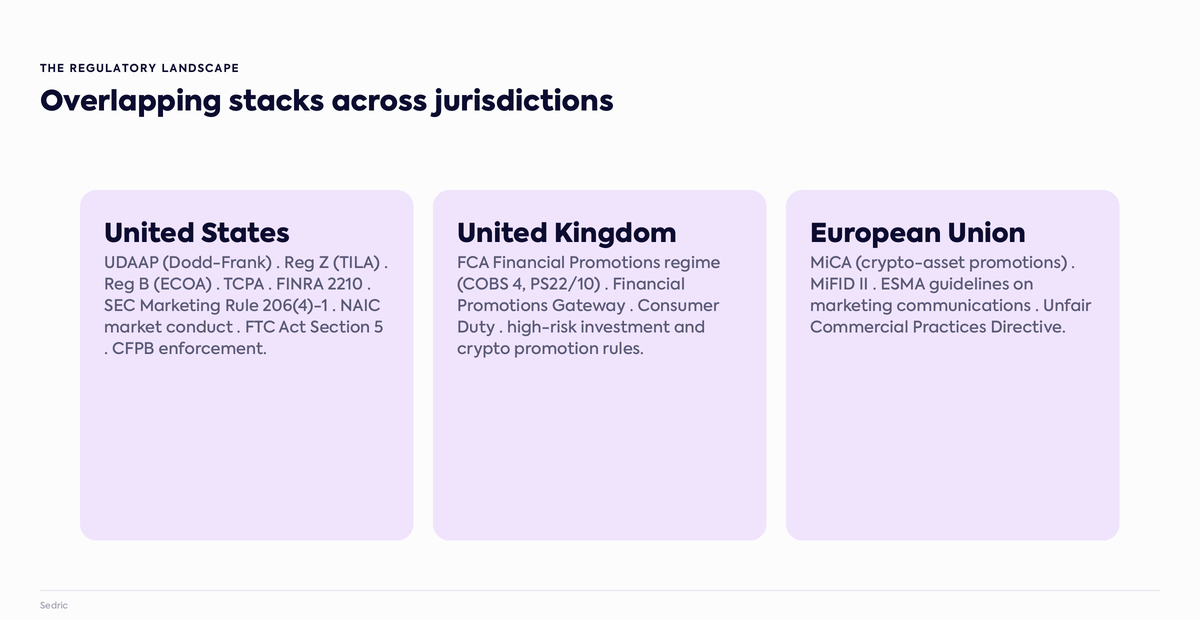
Firms operating across borders are typically subject to several of these stacks at once, which is one reason content compliance has moved from a periodic review activity to a continuous one.
A mature content compliance program operates on four parallel tracks. All four need to work together; a weakness in any one is where enforcement findings land.

Every asset should be reviewed against the applicable policy library before it ships. In a modern program this happens inside the tools where content is created — Figma, the DAM, the CMS, the email platform — not in a separate ticketing queue. Prevention is cheaper than correction, and the only control regulators consistently credit.
Content changes after it ships. Affiliate landing pages get A/B tested, social posts get boosted with new variants, agents paraphrase a script. Detection is the continuous scanning layer that catches drift, unauthorized variants, and partner-run content that never came through the pre-publication queue in the first place.
When content is flagged — pre or post — someone needs to resolve it quickly. Correction means routing to the right team, documenting the fix, re-reviewing, and in some cases pulling content down. Mean time to resolution is a core content compliance KPI.
Every review, every flag, every override, every resolution should be queryable from one place and tied to the specific regulation or policy the finding was raised under. The audit trail is what examiners actually review when something goes wrong. A content compliance program without a reconstructable audit trail is operationally equivalent to not having a program.
The content compliance operating model most firms inherited was designed for a world where marketing produced a handful of campaigns per quarter and compliance reviewed them in a weekly meeting. That model no longer scales. Three breakages are consistent across firms:
Sampling becomes the only option. When content volume outpaces review capacity, compliance teams sample. Sampling is defensible to a point; regulators have signaled that it is no longer sufficient on its own for consumer financial content, call recordings in regulated contexts, and partner-run promotions.
Pre-publication becomes a bottleneck. Marketing teams either wait, which slows campaigns, or route around compliance, which generates risk. Both outcomes are visible to the business and both erode the compliance function's standing.
Post-publication is nobody's job. The content that lives in the wild — updated affiliate pages, re-cut social variants, ad creative pushed through self-service platforms — rarely gets reviewed again after launch. This is where most enforcement findings originate.
The structural answer isn't more reviewers. It is a shift from manual, sample-based review to continuous, policy-driven detection with human judgment reserved for the cases that need it.
The platforms purpose-built for content compliance in the AI era share a common architecture:
Sedric is built on this architecture. The platform covers marketing, communications, partner content, and live-agent review through a single audit trail, with policy coverage across FINRA, SEC, CFPB, FCA, MiCA, MiFID II, ESMA, NAIC, and CySEC.
The playbook is similar across industries; the specific regulations and content surfaces differ.

Primary regs: UDAAP, Reg Z, Reg B, TCPA, FTC Section 5, state market conduct, FCA for UK operations. Content surface: deposit and credit marketing, loan disclosures, overdraft messaging, partner (BaaS, co-brand) programs. Content compliance here is often the gating function for new partner go-live.
Similar to banks, with heavier exposure to influencer and affiliate content, social-first distribution, and in-app content velocity. The partner-content surface is often where risk concentrates.
Primary regs: NAIC market conduct standards, state-level advertising and sales practice rules, FTC Section 5. Content surface: direct-to-consumer marketing, agent-produced email and social content, policy illustrations. Compliance review of distributed-agent content is a persistent challenge.
Primary regs: FINRA 2210, SEC Marketing Rule (206(4)-1), SEC advertising rules, FCA (for UK operations), MiFID II (EU), ESMA. Content surface: performance claims, testimonials and endorsements, research content, communications with the public. Testimonial and performance-claim rules have been a high-risk area since the Marketing Rule took effect.
Primary regs: MiCA (EU), FCA financial-promotions regime (UK), state-level and SEC/CFTC actions (US). Content surface: promotional sites, finfluencer campaigns, exchange marketing. One of the fastest-evolving content compliance surfaces, with new jurisdictional obligations arriving quarterly.
Primary regs: FDCPA, Regulation F, UDAAP, state collection rules. Content surface: call scripts, letters, dialer messages, agent live communications, complaint-adjacent interactions. The communications channel — call monitoring — is where most risk sits.
The buying criteria that separate strong content compliance platforms from marketing automation tools with a review workflow bolted on:
Firms moving to continuous content compliance typically follow a crawl-walk-run sequence over 90 to 180 days.

Crawl: policy library and baseline. Document the applicable regulatory stack and firm policies. Translate them into a structured policy library — ideally in the format the platform you'll use expects. Baseline current volumes and current review coverage so you can measure the gap.
Walk: parallel run on one channel. Deploy the platform on the highest-risk channel (often paid marketing or partner content) in parallel with existing review. Measure detection accuracy, false-positive rate, and time-to-resolution against your current baseline on the same content.
Run: expand to full coverage. Extend to additional channels (communications, agent-assist, additional partner programs). Shift sampling-based review to exceptions-based review, with human judgment reserved for complex or novel findings.
The KPIs that matter for a modern content compliance program:

Marketing compliance is a subset of content compliance. Content compliance also covers communications (calls, chats, emails), partner-run content, and live-agent interactions.
In the US: CFPB, FTC, FINRA, SEC, NAIC, state banking and insurance regulators. In the UK: FCA. In the EU: ESMA and national competent authorities under MiFID II and MiCA. The specific mix depends on your product and jurisdiction.
AI-generated content has multiplied content volumes, pushing most firms past the point where manual review alone is defensible. On the other side, LLM-based review engines now make it possible to review every piece of content against a structured policy library in seconds, with citations.
Pre-publication review catches violations before content goes live — cheaper, cleaner, and the only control regulators consistently credit. Post-publication monitoring catches drift, unauthorized variants, and partner-run content that never came through the pre-publication queue.
Treat partner content as in-scope — regulators do. The typical solution is a continuous scanning layer that monitors live partner pages, ads, and promotional content against the firm's own policy library, with findings routed to the partner's compliance contact for remediation.
A single-channel parallel run typically takes 45–60 days. Multi-channel full coverage typically completes within 90–120 days.
Every review decision, the content reviewed, the rule or policy that produced any flag, the resolution action taken, who took it, and when. Everything should be queryable in one place; cross-channel questions should be answerable in minutes.
If you want to see how a modern content compliance platform reads your actual marketing, communications, and partner content — and what citation-grounded findings look like against the regulations in your stack — book a 30-minute working session. We'll run Sedric against your real assets and show you the findings, the citations, and the audit export in that session.

Convert your static procedures into active AI controllers that protect your brand 24/7.




.svg)

Scale marketing compliance without slowing down.