Share article on


.svg)


— RIA compliance software is the category of platform regulated investment advisers use to manage marketing review, communications surveillance, books and records, supervision, and examination evidence. The category is well-established but has evolved sharply since the November 2022 SEC Marketing Rule compliance date and the ongoing wave of off-channel communications enforcement. Serious tools now combine policy execution and supervisory documentation in a single audit trail; legacy tools that only file or only archive are increasingly insufficient. This guide explains the category, walks through the three core use cases, lays out the evaluation criteria that distinguish production-ready platforms from demoware, and frames the ROI conversation with the CFO and the operating committee.
RIA compliance software is the category of platform that registered investment advisers use to operationalise their compliance programme — particularly the parts of the programme that scale poorly with manual work: marketing review under the SEC Marketing Rule (Rule 206(4)-1), communications surveillance under Rule 204-2 (and Rule 17a-4 for dual-registrants), supervisory documentation, and examination evidence.
What the category is:
What it isn't:
The category split in two over the past three years. Filing-and-form platforms (Form ADV preparation, Form CRS delivery, compliance calendars, attestations) continue to do that work well, but they are not built to review every piece of marketing content or every customer communication in real time. Surveillance and review platforms (eComms archives, marketing review systems, agent guidance tools) are designed for that workload but historically had limited integration with the rest of the programme. The current generation of platforms — Sedric included — combines both surfaces on a single audit trail.
If a vendor cannot articulate clearly which of these three use cases their product addresses — and which it does not — assume the product is narrower than the sales narrative suggests.
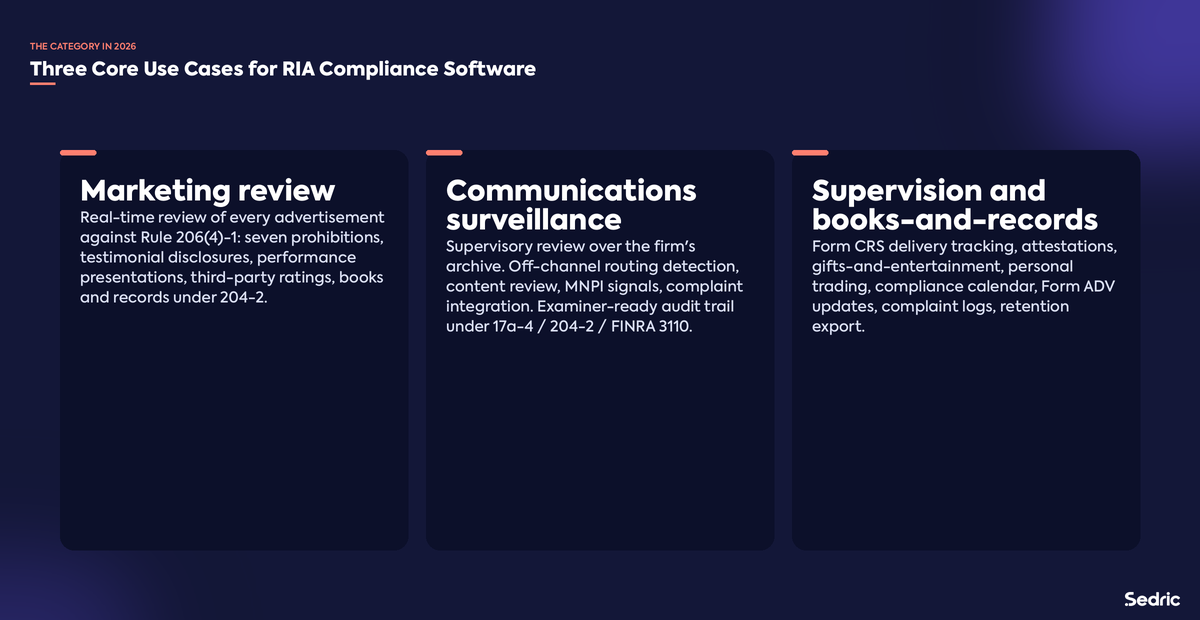
The system reviews marketing content before publication against a configurable rule library mapped to Rule 206(4)-1 — the seven general prohibitions, the testimonial and endorsement disclosure requirements, the third-party rating conditions, the performance-advertising standards (including gross-net presentation, prescribed time periods, and hypothetical-performance restrictions), and the firm's internal policies. It flags potential issues with citations, routes to the right reviewer or supervisory principal, version-controls drafts, and produces an audit-ready export.
Inputs: websites, paid digital, social posts, video, podcasts, podcast read-out scripts, RFP responses, pitch decks, investor letters, factsheets, performance reports, influencer copy.
Outputs: flagged items with rule citations, approval workflow, audit trail, books-and-records retention compliant with the 5-year / 2-year-easily-accessible requirement.
Where it pays back: cycle-time reduction on creative review (often 40 to 60 percent), principal-bottleneck relief, defensible documentation for SEC and state examinations, faster speed-to-market for marketing.
This is the use case most directly tied to the November 2022 Marketing Rule compliance date and the steady enforcement that has followed. Firms that built or extended their platform here are largely surviving exams; firms that did not are not. The dedicated SEC Marketing Rule pillar covers the rule in full.
The system reviews recorded communications — email, chat, recorded calls, internal messaging, social DMs — for risk patterns: undisclosed terms, prohibited claims, missed disclosures, complaints, employee conduct outside policy, the "off-channel" communications scandal pattern. It samples 100 percent of communications rather than the 2 to 5 percent that manual QA can cover, and it produces the records the firm must retain under Rule 204-2 (advisers) and Rule 17a-4 (broker-dealers and dual-registrants).
Inputs: email archive, chat archive, recorded calls, employee mobile communications, social DMs, Bloomberg messages, Teams, Slack, screen capture for trading desks.
Outputs: risk-scored interactions with timestamped flags, citations to firm policy and regulatory rule, trend analytics by adviser, team, branch, or product.
Where it pays back: examiner-facing supervisory documentation that the firm actually reviews communications (the heart of the off-channel enforcement cycle), branch-level OSJ supervision evidence, complaint-handling integration. The dedicated communications compliance pillar covers this in full.
The system manages the firm's supervisory infrastructure: code-of-ethics attestations, gifts-and-entertainment logs, personal trading reviews, outside business activities, political contributions tracking, the compliance calendar, Form ADV update workflow, Form CRS delivery tracking and posting, complaint logs, and the firm's books and records retention.
Inputs: employee directories, brokerage feeds, calendar data, attestation responses, complaint records, Form ADV current state, Form CRS asset library.
Outputs: completed attestations on schedule, supervisory reports, exam-ready filing packages, regulatory filing reminders, retention audit trails.
Where it pays back: programme administration time savings, examiner-facing book-of-record completeness, fewer attestation-cycle fire drills.
A serious RIA compliance platform addresses all three use cases on a shared rule library and a shared audit trail. Fragmenting them is operationally expensive and creates the inconsistency examiners notice when the marketing programme says one thing, the agent communications say another, and the supervisory documentation says a third.
The RIA compliance software landscape has several distinct product families. The boundaries are blurring, but understanding the categories helps frame the evaluation.
Historically built around Form ADV preparation, attestation workflow, gifts-and-entertainment logs, and the compliance calendar. Strong on programme administration. Less mature on real-time content or communications review. Examples include RIA-focused offerings like RIA in a Box (now COMPLY), MyComplianceOffice, and ComplySci.
Built for advertising and content compliance. Strong on workflow, rule libraries, and disclosure-template enforcement. The strongest of these support real-time review during creation rather than only at the approval stage. Sedric sits in this category and extends it into communications and supervision; PerformLine focuses on partner and lead-source content; Hearsay (now part of Yext) focuses on social and digital marketing for adviser networks.
Built around eComms retention and surveillance. Strong on archive completeness and retrieval; varies on supervisory review intelligence. The major archive vendors — Smarsh, Global Relay, Bloomberg Vault — provide the archive layer that retention regulations require, but surveillance intelligence over the archive varies. Theta Lake focuses specifically on video, voice, and unified-communications surveillance.
Built around personal trading compliance and market abuse. Strong on broker-feed integration and pre-clearance workflow. Less relevant for the Marketing Rule and content surveillance.
The newer category of platform — purpose-built for the Marketing Rule era and the off-channel enforcement cycle — combines real-time review, communications surveillance, and supervisory documentation on a single rule library and a single audit trail. Sedric is built for this. The architectural shift is what most firms now buy for: a unified system of record across marketing, communications, and supervision, with one export an examiner can audit.
The most common question in vendor evaluations in 2026 is some version of: "Why can't we use GPT or Claude with retrieval-augmented generation over the CFR and our marketing assets?" Three reasons.
1. Hallucination cost is asymmetric. A general model that fabricates a citation in a casual setting is mildly embarrassing. A compliance tool that fabricates "this is acceptable under Rule 206(4)-1(d)(3)(ii)" produces the worst kind of finding — documented bad reasoning, retained in the books and records, surfaced in the next examination. A compliance-dedicated model has to be grounded in the actual regulatory text and the firm's policy library, with retrieval that surfaces the exact clause, and it has to refuse to opine when grounding is weak.
2. Compliance reasoning is not summarisation. The model has to apply a rule to a fact pattern with the awareness that the fact pattern is adversarial. The marketer is trying to make the claim work; the adviser is under pressure to communicate succinctly; the disclosure is being read fast; the agent on the phone is trying to close. General models trained on internet text are not optimised for the adversarial reading regulators actually do.
3. Audit trail is the product. A general model returning an answer is not auditable in the form examiners expect. A compliance system must capture what the input was, what flags fired, which rules were cited, what the reviewer decided, why they overrode (if they did), and who approved. That is workflow, not a prompt-response pattern, and it is what a Marketing Rule, 204-2, or 17a-4 exam requests look for in evidence.
The serious platforms in the category are built on compliance-dedicated models — trained specifically on regulatory text and reviewed compliance decisions, and grounded in retrieval that links every output to a citation. The reviewer always sees the rule, always sees the reasoning, and always has the override on record.
Use these to separate serious vendors from demoware.
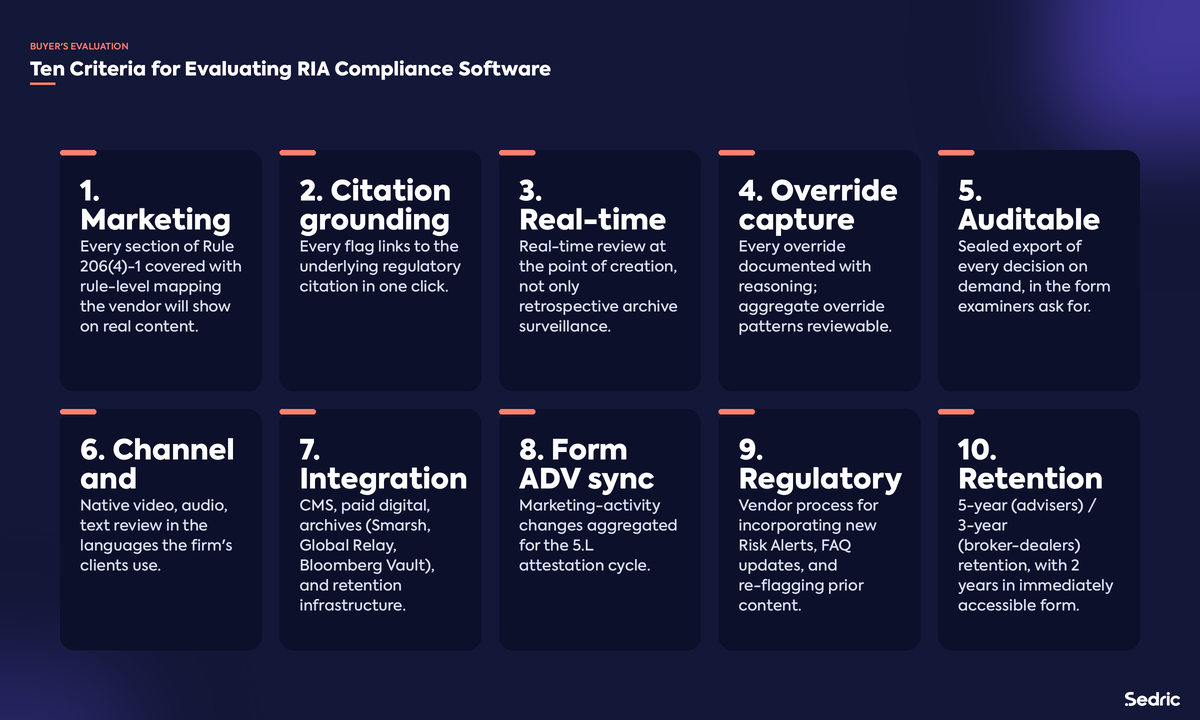
Ask: "Show me how you handle the seven general prohibitions, the testimonial and endorsement disclosure requirements, the third-party rating conditions, and the gross-net presentation requirement for performance." A serious vendor demonstrates these directly on the firm's actual content. A weak vendor gestures at "Marketing Rule readiness" without showing rule-level mapping.
Every flag must link to the underlying regulatory citation — Rule 206(4)-1(a)(2) for unsubstantiated statements, Rule 206(4)-1(b)(1)(iii) for missing testimonial disclosures, Rule 206(4)-1(d)(1)(i) for gross-only performance — and the citation must be one click away for the reviewer. Test this on content that touches edge cases.
Can the system run in the creator's workflow (real-time prevention) or only on completed assets and communications (retrospective archive)? Both have value, but prevention is the higher-leverage use case for marketing content because it stops the issue before it becomes an examiner finding. If the vendor only does retrospective marketing review, the firm is buying a more sophisticated lexicon — useful but not the category leader.
Every override should require a documented reason. Aggregate overrides should be reviewable by the chief compliance officer — repeat overrides on the same flag pattern signal either a rule-library tuning need or a culture problem. If the platform does not surface this, the system decays in eighteen months.
Can the firm produce, in under an hour, a sealed export of every decision on a given advertisement or communication, including who reviewed, when, why, and the rule applied? If yes, the platform is examiner-ready. If no, the firm has built more documentation work, not less. Ask to see a sample export.
Marketing content is multi-channel and increasingly multilingual. Communications are multi-channel by definition. The platform must natively review video, image, text, and audio in the languages clients use. Translation pipelines lose nuance and create their own compliance risk.
How does the platform integrate with the marketer's authoring environment (CMS, Adobe, Canva, paid-digital platforms)? With the email and chat archive (Smarsh, Global Relay, Bloomberg Vault, Microsoft Purview)? With the firm's e-discovery and books-and-records retention infrastructure? Integrations are where deployments stall.
Marketing-activity changes drive Form ADV Section 5.L attestations. Does the platform aggregate marketing activity in a way that supports the firm's ADV update process? Misalignment between Section 5.L answers and actual marketing activity is itself an examiner finding.
When the SEC publishes a Risk Alert or updates the Marketing Compliance FAQs, what is the vendor's process to update the rule library, and how quickly do previously approved assets get re-flagged? A vendor with no answer is selling a snapshot, not a service.
The platform must support the 5-year retention requirement with the first 2 years in immediately accessible form, for advertisements and the substantiation behind them. For dual-registrants, the platform must extend retention to the 3-year FINRA 2210 requirement and the 17a-4 e-communication requirements. Ask to see how retention is structured and what export looks like.
We have seen what succeeds and what stalls across dozens of RIA and dual-registrant deployments.
Pattern 1: Pilot on a single channel and a single asset class. Pick the highest-volume, highest-risk surface. For most wealth managers, that is paid digital marketing for the flagship retail product or the most-active adviser team. Prove the workflow and audit trail, then expand.
Pattern 2: Co-develop the rule library with the vendor in the first 30 days. Out-of-the-box rules cover roughly 70 percent of what the firm needs. Internal policy overlays — house performance methodology, product-specific disclosures, branch-specific supervisory rules — cover the rest. Allocate compliance time to this; it is the highest-leverage 40 hours of the engagement.
Pattern 3: Bring the marketers and the advisers in early. The platform succeeds when creators trust it. That means visible flag rationale, clear override paths, and an intake form that takes under two minutes. A platform that requires marketers to context-switch dramatically reduces usage; a platform that lives in their authoring tool drives compliance into the design phase.
Pattern 4: Use the override log as a management tool. Monthly review of override patterns surfaces both rule-library tuning needs and team training opportunities. The override log is where programme maturity shows up over twelve months; the firms that ignore it see their flag rates climb and their override rates climb together — a sign the system is being routed around rather than improved.
Pattern 5: Build the exam-ready export early. Have the audit export defined, sealed, and tested before the first exam cycle. Reverse-engineering it under exam pressure is a bad place to start. The strongest firms run a mock exam against the platform in the first ninety days of deployment.
The CFO does not buy "compliance AI." They buy one of three things:
Frame the conversation in the language the business actually speaks. "Reduced exam risk" is true but vague. "Cycle time on retail marketing from 8 business days to 3, with full Marketing Rule audit trail attached" is a number marketing will fight for.
The SEC is not opposed to AI in compliance — it is skeptical of AI in client-facing decisions and increasingly clear about expectations.
Key principles emerging from SEC, FINRA, NYDFS, and state authorities:
The good news for AI used in compliance review and surveillance — as opposed to client-facing decisioning — is that the regulatory frame is well-developed and consistent with how a serious platform operates: explainable, cited, human-accountable, audit-logged.
Sedric is built for this category. The platform addresses the three core use cases — Marketing Rule review, communications surveillance, and supervisory documentation — on a single rule library and a compliance-dedicated LLM trained on regulatory text and reviewed compliance decisions.
Every flag is cited to the underlying Marketing Rule, 204-2, or firm policy. Every override is logged with reasoning. The audit export is what an SEC examiner asks for, not what the marketing team thought to retain. The platform integrates with the marketer's authoring tools, the firm's email and chat archives (Smarsh, Global Relay, Bloomberg Vault, Microsoft Purview), and the books-and-records retention infrastructure.
Customer firms range from emerging RIAs with $250M in AUM to dual-registrants with multi-billion-dollar AUM and complex finfluencer programmes. The architecture is the same. The policy library and audit trail adapt to the regulator, the products, and the channels.
The differentiator customers cite is not the model. It is that the model is grounded in regulation, the workflow produces evidence in the form exams require, and the prevention happens in the marketer's authoring environment and on the adviser's live communications — not just after the fact.
The archive is the system of record for retention. A surveillance and review platform is the system of action over the archive. They are complementary — the archive holds the communications, the platform identifies which ones the firm needs to act on, applies the policy library, and produces the supervisory evidence. Most firms run both. Sedric integrates with the major archives rather than replacing them.
No. Filing tools handle the preparation and submission of regulatory forms. A compliance and review platform handles the activity those forms describe. The two layers should be kept distinct; the platform should aggregate marketing-activity data in a way that supports the firm's Form ADV update workflow but does not replace the filing system.
Four to six weeks for a focused single-channel pilot. Three to six months for a multi-channel, multi-entity rollout depending on integration scope and rule-library customisation.
A compliance-dedicated vendor can describe its training corpus: the regulatory text covered (Investment Advisers Act and rules thereunder, the Marketing Rule release, SEC FAQs, Risk Alerts, enforcement orders), the labeled reviewer decisions, the channels, the asset types, the languages. A vendor that cannot describe this is wrapping a general LLM.
A serious platform parses performance presentations and validates the gross-net pairing on time-period, methodology, and visual prominence. Gross-only presentations are flagged before publication. Hypothetical performance is flagged against audience suitability, and mass-market distribution of hypothetical performance is blocked unless the policy library specifically permits it for the recipient class.
The platform validates the three required disclosures at the point of dissemination (speaker status, compensation, conflicts), enforces the standalone-asset requirement (each Story, Reel, post, or video must carry its own disclosure), and integrates the written-agreement workflow for promoters compensated more than US$1,000 in any twelve-month period.
A serious vendor updates the rule library when the SEC publishes new guidance and re-flags previously approved content where appropriate. The December 2024 Risk Alert and the January 2026 FAQ update both produced rule-library changes for our platform within the calendar quarter.
Yes. The platform supports Rule 206(4)-1 (SEC) alongside FINRA Rule 2210 (broker-dealers) for dual-registrants. The two regimes overlap substantially in content standards but differ in supervisory and retention specifics; the platform handles both.
English natively; Spanish coverage is mature; other languages depend on the firm's audience footprint. The platform processes video, audio (podcasts, sponsored read-outs), and text on a single rule library.
Apply the firm's standard third-party risk framework: data handling and residency, model governance, SOC 2 / ISO 27001 posture, business continuity, regulatory references, customer references at AUM scale, and a documented process for handling SEC subpoenas or examiner requests.
A serious vendor will pilot on the firm's real content for thirty days before procurement commitment. This is the right way to assess fit, not a sandboxed demo with vendor-curated examples.

Sedric is purpose-built for the SEC Marketing Rule and the broader RIA and wealth-management compliance stack. Our platform reviews every advertisement and customer communication against the relevant rule library before it ships, captures the audit trail an examiner expects, and operates inside the workflows your marketers and advisers already use.
Book a working session with our team and we'll walk through the three core use cases on your actual content — your website, social, paid digital, performance presentations, eComms archive, and any compensated promoter or third-party rating arrangements. You'll see real flags on real assets, with citations to the specific rule prohibition or condition, and the audit export you would hand to an SEC examiner.
Book a demo · Marketing compliance product · For wealth managers and trading firms
Convert your static procedures into active AI controllers that protect your brand 24/7.



.svg)

Scale marketing compliance without slowing down.