The Fair Debt Collection Practices Act (FDCPA)
is the foundational federal statute governing third-party debt collection in
the United States. Since 1977 it has prohibited specific abusive, deceptive,
or unfair collection practices. In 2026, the FDCPA continues to drive the
largest single share of consumer-protection enforcement and class-action
exposure in the collections industry. This is the operator's checklist —
sixteen items, mapped to the specific FDCPA section and where Reg F overlays
the rule.
What the FDCPA Covers
The FDCPA applies to third-party debt collectors — agencies, debt buyers,
and attorneys collecting on behalf of others — when collecting consumer debt
(debt for personal, family, or household purposes). First-party creditors
collecting their own debt are not directly covered by the FDCPA but face
parallel obligations under state UDAP statutes and CFPB UDAAP authority.
The statute's six substantive areas:
Communications with consumers and third parties — when,
how, and with whom collectors can communicate (§§ 1692c, 1692b).
Harassment or abuse — prohibitions on threats, profane
language, repeated calls, and similar conduct (§ 1692d).
False or misleading representations — bans on false
statements about the debt, the collector, or legal action (§ 1692e).
Unfair practices — prohibitions on collecting amounts
not authorised, using post-dated checks improperly, or non-authorised
fees (§ 1692f).
Validation of debts — the consumer's right to dispute
and the collector's obligation to verify (§ 1692g).
Civil liability — actual damages plus statutory
penalties to $1,000 per violation, plus attorneys' fees (§ 1692k).
The CFPB's 2021 Regulation F adds operational specificity — call
frequency, communications media, validation notice format. Modern FDCPA
compliance means operating to both the statute and the regulation.
Why FDCPA Compliance Matters in 2026
Three forces have raised the operational bar:
The CFPB's supervisory cadence has accelerated. The
Bureau's 2024-2025 examination programme has focused heavily on
debt-collection, with particular emphasis on validation notice compliance,
call-frequency rules, and credit-reporting accuracy.
State AGs are filing significant actions. Multi-million-dollar
settlements have become routine. State-level cures often impose monitoring
requirements that exceed federal baseline.
Class-action exposure compounds. A single mishandled call
surfacing in discovery can ground a class action with statutory damages
multiplied across the affected population.
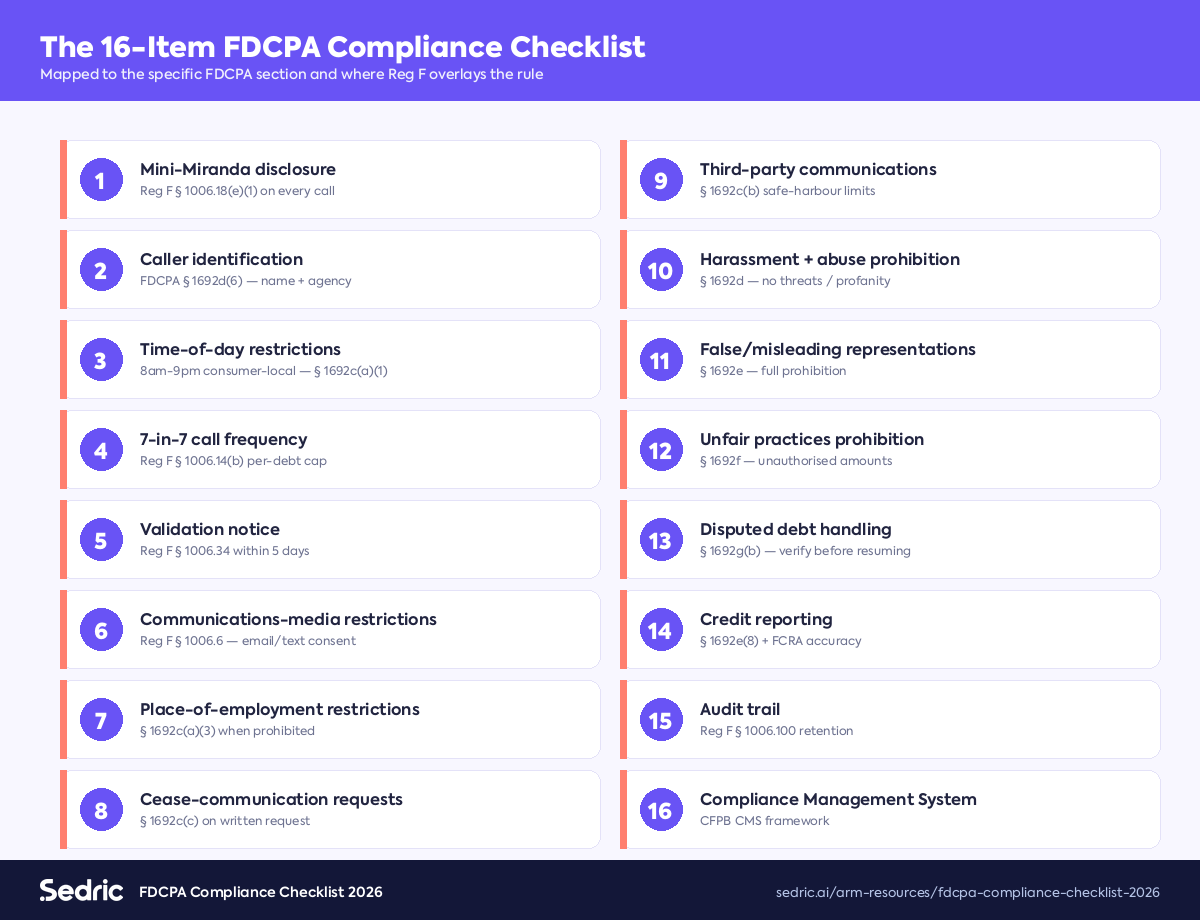
The 16-Item FDCPA Compliance Checklist
Mini-Miranda disclosure. Every collection call opens
with the prescribed disclosure: "This is an attempt to collect a debt and
any information obtained will be used for that purpose." Reg F § 1006.18(e)(1).
Caller identification. The collector identifies themselves
and their agency by name. § 1692d(6).
Time-of-day restrictions. No calls before 8 a.m. or after
9 p.m. consumer-local time, unless the consumer consents otherwise.
§ 1692c(a)(1).
7-in-7 call frequency. Reg F caps collection calls at 7
per debt per 7 days, with a 7-day quiet period after talking with the
consumer. § 1006.14(b).
Validation notice. Within 5 days of the initial communication,
provide the Reg F-specified validation notice with itemisation, current
balance, account information, and consumer-protection statements. § 1006.34.
Communications-media restrictions. Email and text only
with consumer consent (or via the limited-content message safe harbour).
§ 1006.6.
Place-of-employment restrictions. If the consumer or
employer indicates that the employer prohibits such communication, the
collector must stop calling there. § 1692c(a)(3).
Cease-communication requests. Once a consumer requests
in writing that the collector cease communication, the collector must
stop except for specified safe-harbour purposes. § 1692c(c).
Third-party communications. Communications with anyone
other than the consumer (spouse, attorney, guarantor, etc.) are restricted
to specific safe-harbour scenarios. § 1692c(b).
Harassment and abuse prohibition. No threats, profane
language, calls intended to annoy or harass, or repeated calls. § 1692d.
False or misleading representations. No false statements
about amount owed, legal action threatened, collector's identity, or
consumer-rights implications. § 1692e.
Unfair practices prohibition. No collection of unauthorised
amounts, no post-dated checks misused, no deposit threats. § 1692f.
Disputed debt handling. If the consumer disputes the debt
within the validation period, cease collection until the collector verifies
the debt and provides verification to the consumer. § 1692g(b).
Credit reporting. Don't report disputed debt without
noting the dispute; don't report inaccurate information. § 1692e(8); FCRA
overlay.
Audit trail. Every call, message, validation notice,
and consumer interaction logged with timestamp, agent ID, and disposition.
Reg F § 1006.100 retention requirements.
Compliance Management System. Documented policies,
training, monitoring, corrective action, and board-level oversight,
aligned to CFPB CMS expectations.
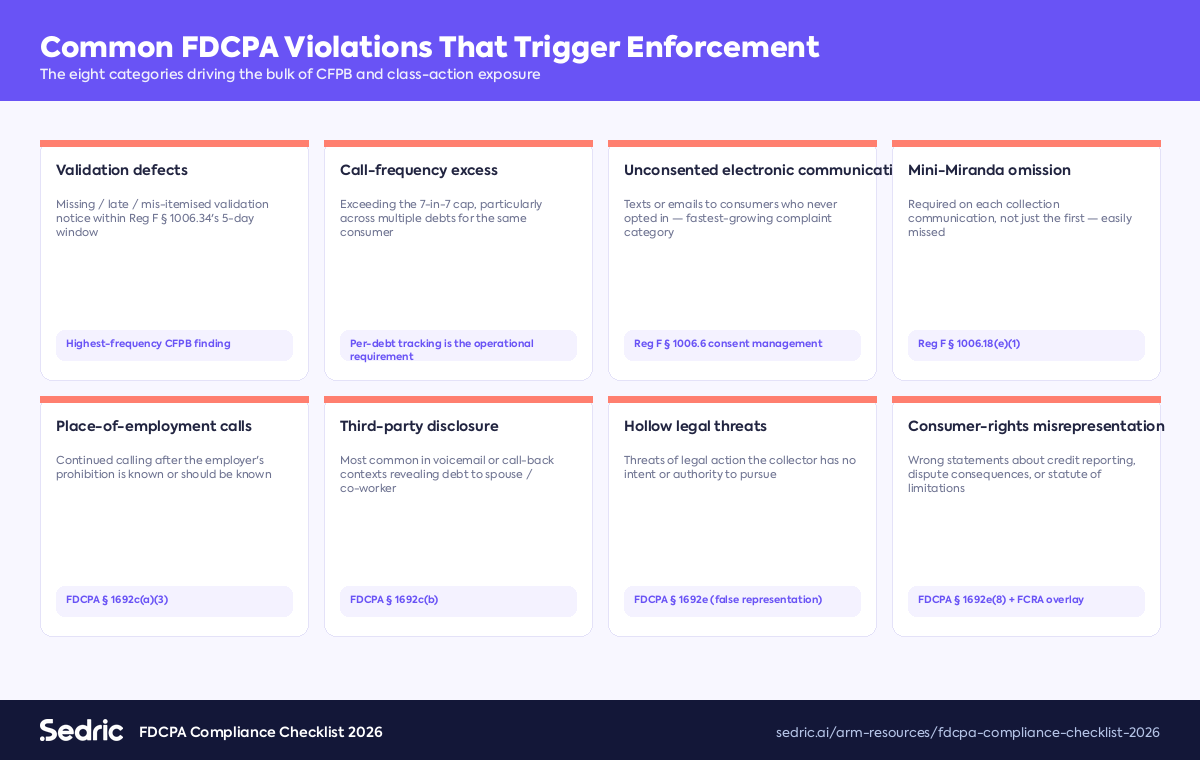
Common FDCPA Violations That Trigger Enforcement
Failure to deliver a compliant validation notice within 5 days.
Calls exceeding the 7-in-7 frequency cap, particularly across multiple
debts attributed to the same consumer.
Texts or emails to consumers who never opted in.
Mini-Miranda omission on subsequent calls (it's required on each
collection communication, not just the first).
Place-of-employment calls after the employer's prohibition is known.
Third-party disclosure of debt status (most commonly to family members
or co-workers in voicemail or call-back contexts).
Threats of legal action that the collector has no intention of taking.
Misrepresentation of the consumer's rights, particularly around credit
reporting and dispute consequences.
How Sedric Helps
Sedric monitors 100% of collection calls and messaging in real time,
scoring each interaction against the full FDCPA + Reg F rulebook plus the
firm's policy library. The agent-assist surface whispers required disclosures
(mini-Miranda, validation, time-of-day) to the agent at the right moment.
Every flag is mapped to the specific FDCPA section or Reg F provision it
engages, and every override is logged with reasoning — the exact audit
trail a CFPB examiner expects.
FAQ
Does the FDCPA cover first-party creditors collecting their own debt?
Not directly. First-party creditors face parallel obligations under CFPB
UDAAP and state UDAP statutes; many also adhere to FDCPA standards voluntarily
to maintain consistency across the collection lifecycle.
What's the statutory penalty for an FDCPA violation?
Up to $1,000 per consumer in statutory damages, plus actual damages and
attorneys' fees. Class actions can multiply this dramatically.
How does Reg F change FDCPA compliance?
Reg F operationalises the FDCPA — adding the 7-in-7 rule, validation
notice format, communications-media rules, and recordkeeping. Modern
compliance means satisfying both statute and regulation simultaneously.
Are voicemails communications under the FDCPA?
Yes. A voicemail counts as a communication. The limited-content message
safe harbour in Reg F § 1006.2(j) provides specific format requirements
that allow a voicemail without triggering third-party disclosure liability.
How long do I need to retain collection records?
Reg F § 1006.100 requires 3 years from the last collection activity for
most records, with longer retention for certain recordings and validation
notice evidence.
The Bottom Line
FDCPA compliance in 2026 is not a static checklist exercise — it's an
operational discipline that must run live, across every collection
conversation, every channel, every state. The firms that handle it well
have real-time monitoring with rule-mapped flagging, agent-assist that
prevents violations before they occur, and an audit trail that survives
both regulator examination and class-action discovery.
See Sedric in action
Sedric is the AI compliance platform for regulated marketing and communications. Every flag is mapped to the specific rulebook provision, every override is logged with reasoning, and the audit trail is the format regulators expect on first request. Book a 30-minute demo and we will walk through your specific compliance footprint.


.svg)


![Featured image for 'FDCPA Compliance Checklist 2026' — Sedric branded [sedric-rebrand-v2]](https://cdn.prod.website-files.com/69a7e1717e5289161221dbf3/6a15f18a7f2f5ce264082ae7_6a15f18512b4bfdc437d7d92_featured-rebrand-fdcpa-compliance-checklist-2026.png)



.svg)
.avif)
![Featured image for 'AI in Debt Collection Compliance: How Agent-Assist Changes the Operating Model' — Sedric branded [sedric-rebrand-v2]](https://cdn.prod.website-files.com/69a7e1717e5289161221dbf3/6a15f17925f21ab4460678fd_6a15f176bd2ec6cdff9602e1_featured-rebrand-ai-debt-collection-compliance-2026.png)
![Featured image for 'State Debt Collection Laws 2026: A Practitioner's Map' — Sedric branded [sedric-rebrand-v2]](https://cdn.prod.website-files.com/69a7e1717e5289161221dbf3/6a15f17ebc29bfe311dd0d28_6a15f17b18c1990398b7991f_featured-rebrand-state-debt-collection-laws-2026-practitioners-map.png)
![Featured image for 'CFPB Reg F: The 2026 Operator's Guide' — Sedric branded [sedric-rebrand-v2]](https://cdn.prod.website-files.com/69a7e1717e5289161221dbf3/6a15f184b9e16b2074c63303_6a15f180de817f5765d9678b_featured-rebrand-cfpb-reg-f-2026-operators-guide.png)